Stainless
Stainless 309S
Annealing Procedure
1900-2050 F (1038-1121 C), water quench.
Applications
Oven linings, boiler baffles, fire box sheets, furnace components and other high temperature containers.
Cold Workability
Although this alloy has a high work hardening rate, it can be drawn, headed, upset, and stamped. Full annealing is required after cold work to remove internal stress.
Hardening Procedure
This alloy does not respond to heat treatment. Cold work will cause an increase in both hardness and strength.
Hot Workability
Working temperatures are 2150 F (1177 C), with reheating necessary at 1800 F (982 C). Rapid quenching is recommended. Full post-work annealing is required to reattain maximum corrosion resistance.
Machinability
This alloy machines similarly to type 304 stainless. Its chips are stringy and it will work harden rapidly. It is necessary to keep the tool cutting at all times and use chip breakers.
Principle Design Features
Basically a controlled carbon version of type 309 stainless designed to improve the weld strength of the alloy while benefiting from the alloy's high resistance to heat and corrosion. Superior corrosion resistance to 309 in the range of 800-1500 F (427-816 C).
Weldability
Most of the austenitic stainless steels can be readily welded using fusion or resistance methods. Oxyacetylene welding is not recommended. Filler metal should be AWS E/ER 309L.
Known Forms
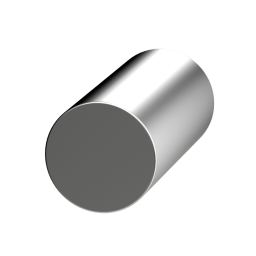
Angle
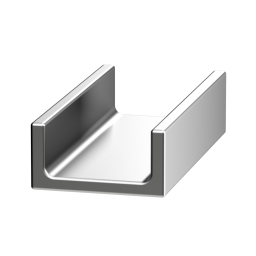
Channel
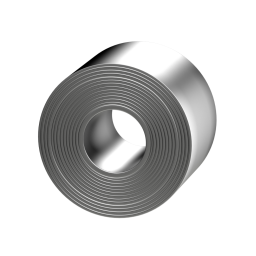
Coil
Disc
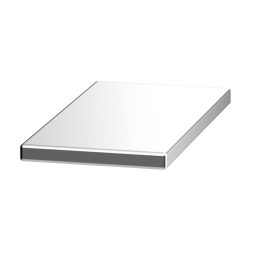
Flat Bar

Foil
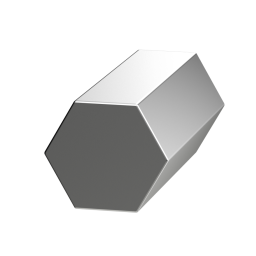
Hexagon Bar
Hollow Bar
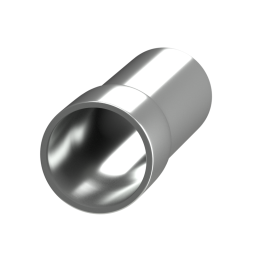
Pipe
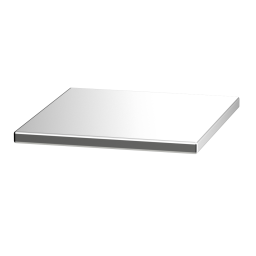
Plate
Precision Ground Bar

Rectangle Tube
Ring
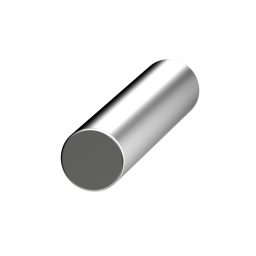
Rod
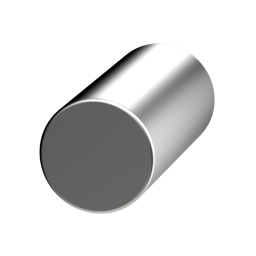
Round Bar
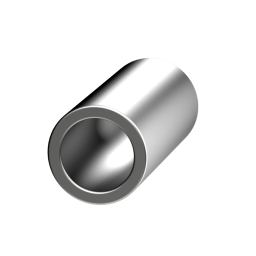
Round Tube
Sheet
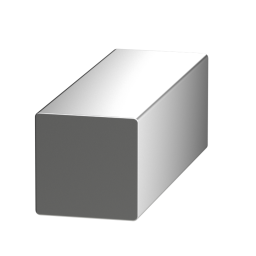
Square Bar
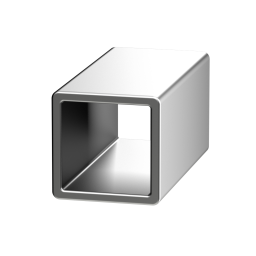
Square Tube
Standard Beam
Strip
Tee
Additional Data
Specifications
309S,5523,5574,5650,A167,A213,A240,A249,A276,A312,A314,A473,A479,A511,A554,A580,A813,A814,1.4833,S30908Chemical Elements
| Carbon | 0.08 max |
| Chromium | 22 - 24 |
| Iron | Balance |
| Manganese | 2 max |
| Nickel | 12 - 15 |
| Phosphorus | 0.045 max |
| Silicon | 1 max |
| Sulphur | 0.03 max |
Physical Properties
Density: 0.29lb/in³
Electrical Resistivity: 468µΩ·cm
Melting Point: 2650°F
Specific Gravity: 7.9
Specific Heat: 0.12BTU/lb·°F
Mechanical Properties
Modulus of Elasticity – Tension: 29MSI
Thermal Expansion
| Condition | Min | Max | Expansion Coefficient |
|---|---|---|---|
| Annealed | 32 °F | 212 °F | 8.3 μin/in·°F |
| Annealed | 32 °F | 1200 °F | 10 μin/in·°F |
| Annealed | 32 °F | 1800 °F | 11.5 μin/in·°F |