Stainless
Stainless 316
Annealing Procedure
1850-2050 F (1010-1121 C), followed by rapid cooling.
Applications
Widely used in industry, it was initially designed for paper mill machinery. It has been used in marine environments and a wide variety of general industrial components.
Cold Workability
Shearing, stamping, heading and drawing can be successfully performed . To remove internal stresses, a post-work annealing is recommended.
Hardening Procedure
This alloy does not respond to heat treatment. Cold work will cause an increase in both hardness and strength.
Hot Workability
All common hot working processes are possible with this alloy. Heat to 2100-2300 F (1149-1260 C). Avoid working this material below 1700 F (927 C). For optimum corrosion resistance, a post-work annealing is recommended.
Machinability
Low speeds and constant feeds will minimize this alloy's tendency to work harden. Tougher than 304 stainless with a long stringy chip, the use of chip breakers is recommended. Many companies now offer premium machinability grades, such as CarTech with their Project 70 and 7000 series.
Principle Design Features
This austenitic stainless steel has an increased molybdenum content to increase its resistance to corrosion when compared to other 300 series alloys. It will resist scaling at temperatures up to 1600 F (871 C) and maintains good mechanical properties and creep strength at high temperatures.
Weldability
All common fusion and resistance methods except oxyacetylene welding have proven successful. Use AWS E/ER316 or 316L filler metal for best results.
Known Forms
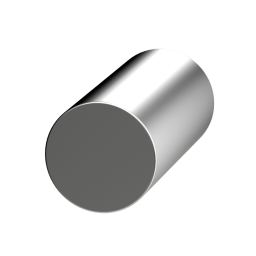
Angle
Bolt
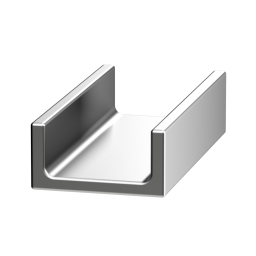
Channel
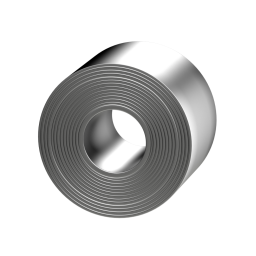
Coil
Disc
Expanded Sheet
Fitting
Flange
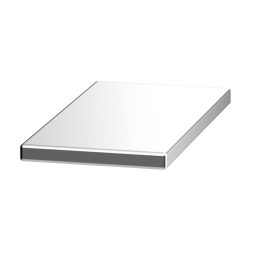
Flat Bar
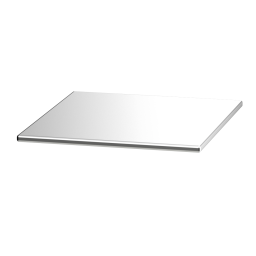
Foil
Grating
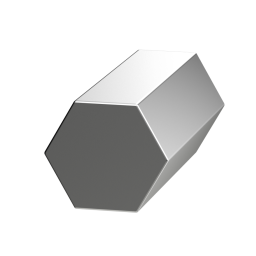
Hexagon Bar
Hollow Bar
Nut
Perforated Sheet
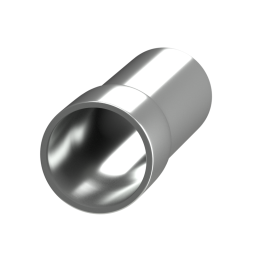
Pipe
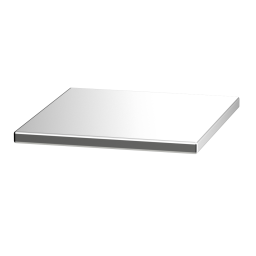
Plate
Powder
Precision Ground Bar
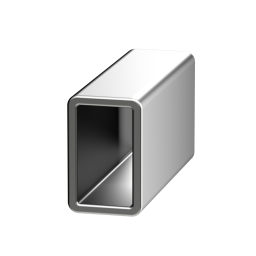
Rectangle Tube
Ring
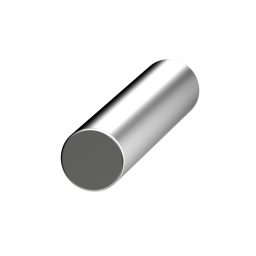
Rod
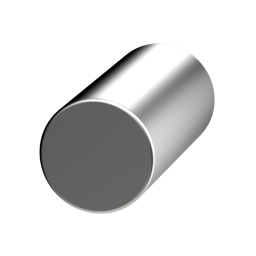
Round Bar
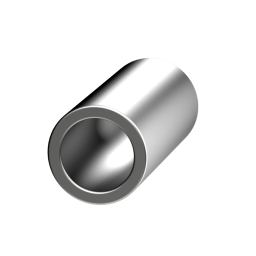
Round Tube
Screw
Sheet
Specialty Form
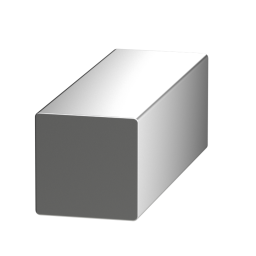
Square Bar
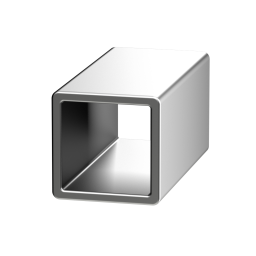
Square Tube
Standard Beam
Strip
Tee
Threaded Rod
Valve
Washer
Wire Flat
Wire Round
Wire Square
Additional Data
Specifications
Z7CND 18-12-03,316,5524,5573,5648,5690,5696,A167,A182,A193(B8M,MA,M2 & M3),A194 (316, 8M, 8MA),A213,A240,A249,A269,A270,A271,A276,A312,A313,A314,A320 (316,B8M,B8MA),A336,A358,A368,A376,A403,A409,A430,A473,A478,A479,A492,A493,A511,A554,A580,A632,A666,A688,A771,A813,A814,A826,F138,1.4401,1.4436,1.4580,S-5059,S-7720,S763,S766,S31600Chemical Elements
| Carbon | 0.08 max |
| Chromium | 16 - 18 |
| Iron | Balance |
| Manganese | 2 max |
| Molybdenum | 2 - 3 |
| Nickel | 10 - 14 |
| Phosphorus | 0.045 max |
| Silicon | 1 max |
| Sulphur | 0.03 max |
Physical Properties
Density: 0.288lb/in³
Electrical Resistivity: 445µΩ·cm
Melting Point: 2550°F
Specific Gravity: 7.95
Specific Heat: 0.12BTU/lb·°F
Mechanical Properties
Modulus of Elasticity – Tension: 28MSI
Thermal Conductivity
| Condition | Temperature | Conductivity |
|---|---|---|
| Annealed | 212 °F | 9.4 BTU/hr·ft·°F |
Thermal Expansion
| Condition | Min | Max | Expansion Coefficient |
|---|---|---|---|
| Annealed | 70 °F | 212 °F | 9.2 μin/in·°F |
| Annealed | 70 °F | 932 °F | 10.1 μin/in·°F |