Stainless
Stainless 316-L
Annealing Procedure
Anneal at 1850–2050°F (1010–1120°C), followed by rapid cooling. Water quench is used for heavier sections; air cooling may be used for lighter sections. Rapid cooling through the sensitizing range (800–1500°F / 427–816°C) is essential to prevent carbide precipitation and maintain maximum corrosion resistance. This treatment dissolves any precipitated phases and restores the single-phase austenitic structure.
Applications
316L is widely used in chemical and petrochemical processing equipment, pharmaceutical processing equipment, food and beverage processing equipment, marine hardware and coastal architectural applications, pulp and paper processing equipment, textile industry equipment, medical and surgical implants, pressure vessels, heat exchangers, tanks, piping systems, flanges, fittings, valves and pumps, pollution control equipment, water treatment systems, and photographic and soap-handling equipment.
Cold Workability
316L stainless steel has excellent cold workability. It can be cold drawn, rolled, and formed using standard equipment. Cold working increases tensile strength and hardness but reduces ductility. The material work hardens significantly with increasing cold reduction, which must be accounted for in multi-pass operations.
Corrosion Resistance
316L offers excellent corrosion resistance in a wide range of environments. The molybdenum content provides enhanced resistance to pitting and crevice corrosion in chloride environments compared to 304L. The low carbon content makes 316L immune to intergranular corrosion (sensitization) in the as-welded condition across any section thickness. 316L has good resistance to oxidation in intermittent service up to 870°C (1600°F) and continuous service up to 925°C (1700°F). It is not recommended for continuous use in the sensitizing temperature range of 425–860°C unless the low-carbon grade advantage is specifically required. 316L is resistant to carbide precipitation in the 425–870°C range, making it suitable for use without post-weld annealing.
Forgeability
316L can be forged in the temperature range of 2100–2300°F (1149–1260°C). Forging should not be performed below 1700°F (927°C). Annealing is recommended after forging to maintain maximum corrosion resistance and restore the optimal microstructure.
Formability
316L exhibits excellent formability due to its austenitic structure. Most common cold working operations including shearing, drawing, bending, and stamping can be performed. The lower carbon content of 316L makes it slightly softer and somewhat easier to cold-form than standard 316. The material work hardens during cold forming, which should be considered when designing multi-stage forming operations.
Heat Treatability
316L cannot be hardened by heat treatment due to its austenitic (FCC) crystal structure. The only applicable heat treatment is annealing (solution annealing), which relieves internal stresses, dissolves precipitated carbides, and restores full corrosion resistance and ductility. Cold working is the only method to increase hardness and strength.
Hot Workability
316L can be hot worked using all common hot working techniques. Optimal hot working temperatures are in the range of 1150–1260°C (2100–2300°F). Hot working should not be performed below 930°C (1700°F). Post-work annealing should be carried out after hot working to restore maximum corrosion resistance.
Machinability
316L stainless steel has moderate machinability, rated at approximately 36–60% of AISI B1112 free-machining carbon steel. The alloy tends to work harden rapidly during machining, requiring sharp cutting tools, moderate cutting speeds, constant feed rates, and adequate coolants and lubricants. Cutting edges must be kept sharp to avoid excessive work hardening. Chip breakers are recommended to keep swarf clear of the work zone.
Other Comments
316L (UNS S31603) is frequently dual-certified with 316 (UNS S31600) when the carbon content of the heat meets both specifications (max 0.03% C for 316L vs. max 0.08% for 316). The European equivalent is DIN 1.4404. 316L is widely used in biomedical implants due to its biocompatibility. It is generally considered 'marine grade' stainless steel, though it is not resistant to warm seawater or concentrated chloride environments where stress corrosion cracking may occur above approximately 140°F (60°C).
Other Physical Properties
316L is non-magnetic in the annealed condition (magnetic permeability max 1.02 at H = 200 oersteds). Cold working may induce slight magnetism due to strain-induced martensite formation. Modulus of elasticity in torsion (shear modulus) is approximately 11.2–11.9 MSI (77–82 GPa). The austenitic structure provides excellent toughness down to cryogenic temperatures.
Principle Design Features
316L is an austenitic chromium-nickel-molybdenum stainless steel, representing the low-carbon (max 0.03% C) version of Type 316. The molybdenum addition (2–3%) provides improved resistance to pitting and crevice corrosion compared to 304/304L. The low carbon content makes 316L immune to sensitization (grain boundary carbide precipitation) in the as-welded condition, eliminating the need for post-weld annealing in most applications. The austenitic structure is non-magnetic in the annealed condition and cannot be hardened by heat treatment; strength can only be increased by cold working.
Weldability
316L has excellent weldability by all standard fusion and resistance methods, both with and without filler metals, including GTAW (TIG), GMAW (MIG/MAG), SMAW (Stick), and SAW. No preheat is required. Post-weld annealing is not required for 316L due to its low carbon content, which prevents sensitization. Oxyacetylene welding is not recommended. Recommended filler metals are 316L or matching composition. For critical corrosion applications, the weld area should be cleaned to restore the passive layer.
Known Forms
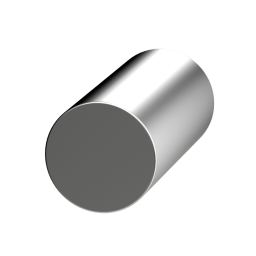
Angle
Bolt
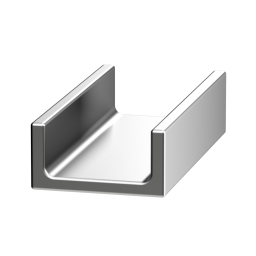
Channel
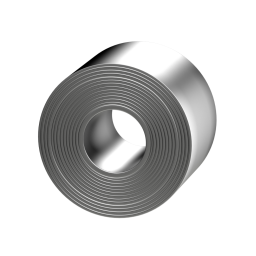
Coil
Disc
Expanded Sheet
Fitting
Flange
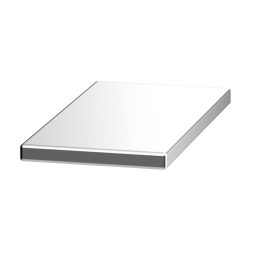
Flat Bar
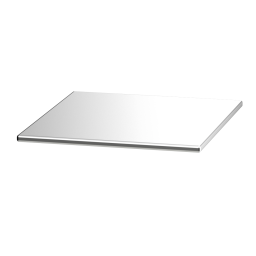
Foil
Grating
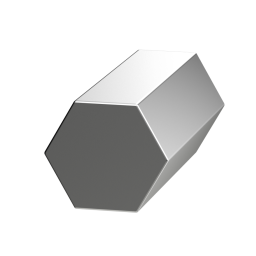
Hexagon Bar
Hollow Bar
Nut
Perforated Sheet
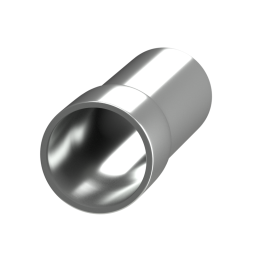
Pipe
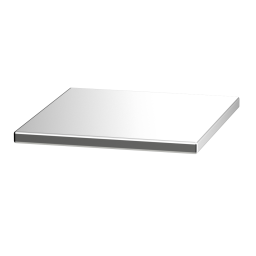
Plate
Powder
Precision Ground Bar
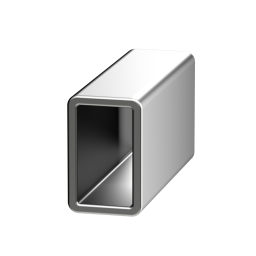
Rectangle Tube
Ring
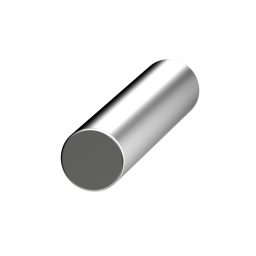
Rod
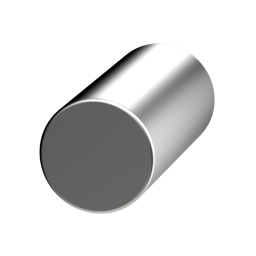
Round Bar
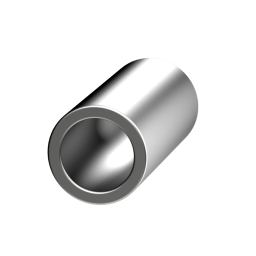
Round Tube
Screw
Sheet
Specialty Form
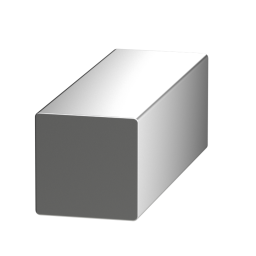
Square Bar
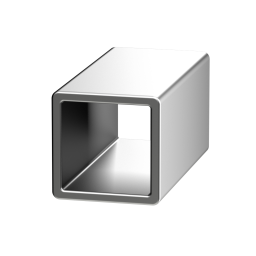
Square Tube
Standard Beam
Strip
Tee
Threaded Rod
Treadplate
Valve
Washer
Wide Beam
Wire Flat
Wire Round
Wire Square
Additional Data
Specifications
5507,5653,A167,A182,A213,A240,A249,A269,A276,A312,A314,A403,A479,A580,A666,F138,S-5059,S31603,SA240,SA276Chemical Elements
| Carbon | 0.03 max |
| Chromium | 16 - 18 |
| Iron | Balance |
| Manganese | 2 max |
| Molybdenum | 2 - 3 |
| Nickel | 10 - 14 |
| Nitrogen | 0.1 max |
| Phosphorus | 0.045 max |
| Silicon | 0.75 max |
| Sulfur | 0.03 max |
Physical Properties
Density: 0.289lb/in³
Electrical Resistivity: 74µΩ·cm
Melting Point: 2500°F
Modulus of Elasticity: 28MSI
Specific Heat: 0.108BTU/lb·°F
Thermal Conductivity
| Condition | Temperature | Conductivity |
|---|---|---|
| Annealed | 212 °F | 9.4 BTU/hr·ft·°F |
Thermal Expansion
| Condition | Min | Max | Expansion Coefficient |
|---|---|---|---|
| Annealed | 32 °F | 212 °F | 8.9 μin/in·°F |
| Annealed | 32 °F | 1000 °F | 9.7 μin/in·°F |
| Annealed | 32 °F | 1500 °F | 11.1 μin/in·°F |
Mechanical Test Data
| Form | Plate |
| Condition | Annealed |
| Temperature | 70°F |
| Brinell Hardness | 217 HB |
| Elongation | 40% |
| Rockwell Hardness | B90 |
| Tensile Strength | 70 KSI |
| Yield Strength | 25 KSI |
| Form | Sheet |
| Condition | Annealed |
| Temperature | 70°F |
| Brinell Hardness | 217 HB |
| Elongation | 40% |
| Rockwell Hardness | B90 |
| Tensile Strength | 70 KSI |
| Yield Strength | 25 KSI |
| Form | Round Bar |
| Condition | Annealed |
| Temperature | 70°F |
| Brinell Hardness | 217 HB |
| Elongation | 40% |
| Rockwell Hardness | B90 |
| Tensile Strength | 70 KSI |
| Yield Strength | 25 KSI |
| Form | Pipe |
| Condition | Annealed |
| Temperature | 70°F |
| Brinell Hardness | 217 HB |
| Elongation | 40% |
| Rockwell Hardness | B90 |
| Tensile Strength | 70 KSI |
| Yield Strength | 25 KSI |