Stainless
Stainless 321
Annealing Procedure
1800-2000 F (928-1093 C), air cool. This procedure will result in maximum ductility. For maximum corrosion resistance, see the note on stabilizing anneal under corrosion.
Applications
Jet engine parts, furnace heat treated parts, expansion joints, turbo superchargers, oil refiners, exhaust manifolds and high temperature chemical production equipment.
Cold Workability
Although this material requires higher initial forces than 304 stainless, it is quite tough and ductile and can be readily stamped, blanked, spun and drawn.
Hardening Procedure
This alloy does not harden by heat treating. Elevated properties may only be obtained through cold reduction.
Hot Workability
Working temperatures of 2100-2300 F (1149-1260 C) are recommended for forging, upsetting and other hot work processes. Do not work this alloy at temperatures below 1700 F ( 927 C). Material must be water quenched or fully annealed after working to reattain maximum corrosion resistance.
Machinability
Slightly tougher than 304 stainless, this material will produce the same tough stringy chips. The use of slow speeds and constant positive feeds will minimize this alloy's tendency to work harden.
Principle Design Features
The key feature of 321 stainless is its resistance to intergranular corrosion. It employs titanium as a stabilizing element against chromium carbide formation. This alloy also exhibits strength characteristics superior to those of 304 stainless.
Weldability
321 may be welded by all commonly used fusion and resistance methods. Oxyacetylene welding is not recommended. When necessary, use AWS E/ER347 filler metal.
Known Forms
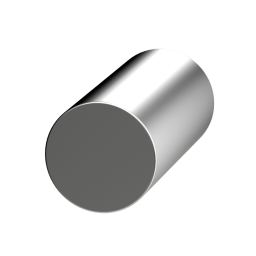
Angle
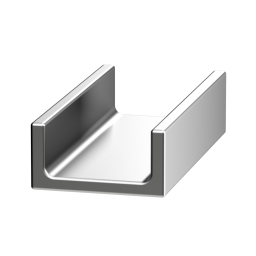
Channel
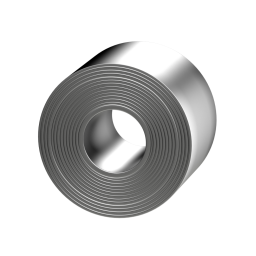
Coil
Disc
Fitting
Flange
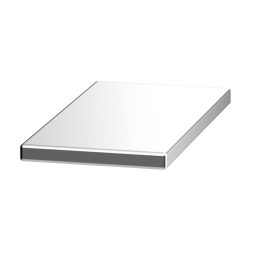
Flat Bar
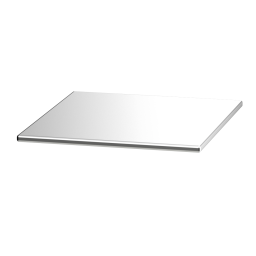
Foil
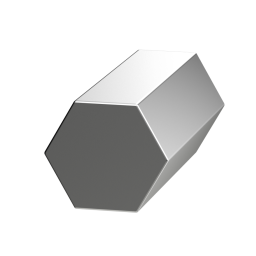
Hexagon Bar
Hollow Bar
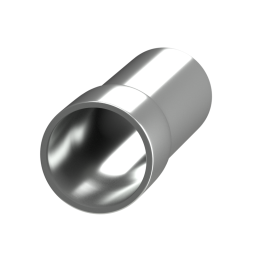
Pipe
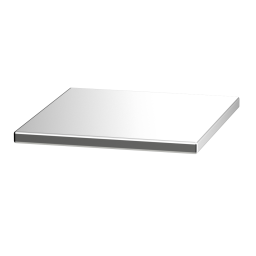
Plate
Precision Ground Bar
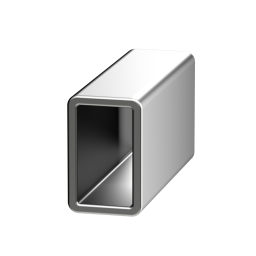
Rectangle Tube
Ring
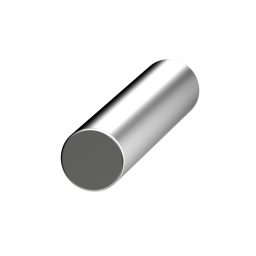
Rod
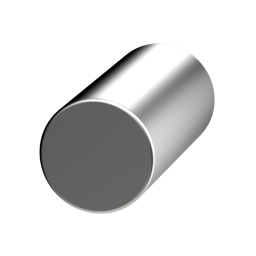
Round Bar
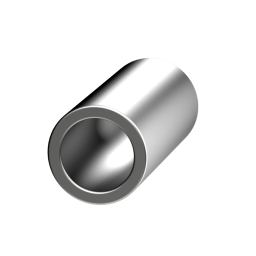
Round Tube
Sheet
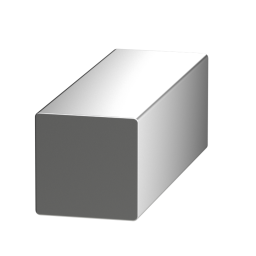
Square Bar
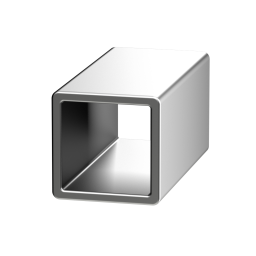
Square Tube
Standard Beam
Strip
Tee
Valve
Additional Data
Specifications
321,5510,5557,5559,5570,5576,5645,5689,A167,A182,A193 (321,B8T, B8TA),A194 (321,B8T, B8TA),A213,A240,A249,A269,A271,A276,A312,A314,A320 (321,B8T, B8TA),A336,A358,A376,A403,A409,A430,A473,A479,A511,A554,A580,A632,A774,A778,A813,A814,1.4541,S-27419,T-6737,S763,S766,S32100Chemical Elements
| Carbon | 0.08 max |
| Chromium | 17 - 19 |
| Iron | Balance |
| Manganese | 2 max |
| Nickel | 9 - 12 |
| Phosphorus | 0.045 max |
| Silicon | 1 max |
| Sulphur | 0.03 max |
| Titanium | Min:5 x C |
Physical Properties
Density: 0.29lb/in³
Electrical Resistivity: 432µΩ·cm
Melting Point: 2600°F
Specific Gravity: 7.9
Specific Heat: 0.12BTU/lb·°F
Mechanical Properties
Modulus of Elasticity – Tension: 28MSI
Thermal Conductivity
| Condition | Temperature | Conductivity |
|---|---|---|
| Annealed | 212 °F | 9.3 BTU/hr·ft·°F |
Thermal Expansion
| Condition | Min | Max | Expansion Coefficient |
|---|---|---|---|
| Annealed | 32 °F | 212 °F | 9.3 μin/in·°F |
| Annealed | 32 °F | 600 °F | 9.5 μin/in·°F |
| Annealed | 32 °F | 1000 °F | 10.3 μin/in·°F |
| Annealed | 32 °F | 1200 °F | 10.7 μin/in·°F |
| Annealed | 32 °F | 1500 °F | 11.2 μin/in·°F |