Stainless
Stainless 330
Annealing Procedure
Soak at 2050-2200 F, air quench.
Applications
Extensively used in high temperature environments where resistance to the combine effects of thermal cycling and carburization is necessary. Used in a variety of furnace components as well as in gas turbines, heat exchangers, general heat treating equipment and neutral and cyanide salt pots.
Cold Workability
Due to its relatively high strength and work hardening rate, 330 is more difficult to cold form than standard 18-8 stainless steels. Expect to use higher forces than normal and note its' elevated springback.
Hardening Procedure
330 will not respond to heat treatment.; it will only harden upon cold reduction.
Hot Workability
Any hot work should commence at 2100-2150 F and finish at 1800 F.
Machinability
With proper practices this alloy can be satisfactorily machined. Slow speeds, positive feeds, sulphurized lubricants and rigid mounts are generally recommended.
Principle Design Features
330 is an austenitic, nickel-chromium-iron-silicon alloy. It combines excellent resistance to carburization and oxidation at temperatures up to 2200 F(1200 C) with high strength.
Weldability
Can be successfully welded using GAW techniques. Use either 330 or Inco 800 filler materials.
Known Forms
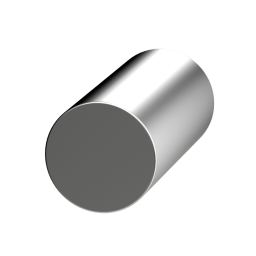
Angle
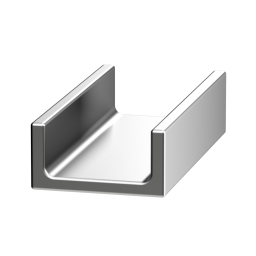
Channel
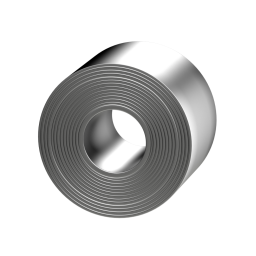
Coil
Disc
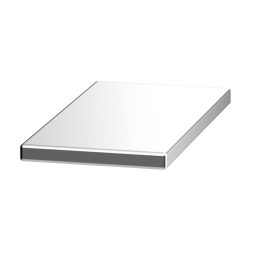
Flat Bar
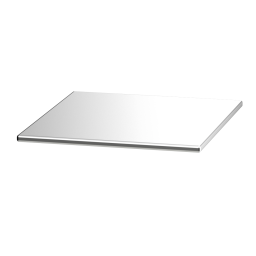
Foil
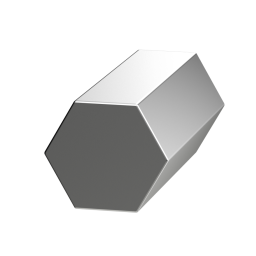
Hexagon Bar
Hollow Bar
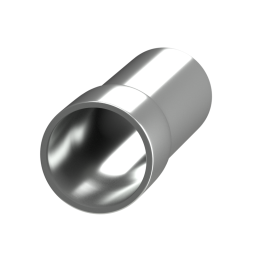
Pipe
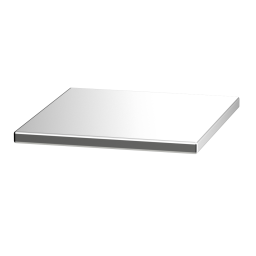
Plate
Precision Ground Bar

Rectangle Tube
Ring
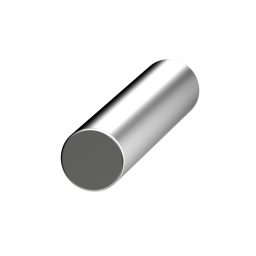
Rod
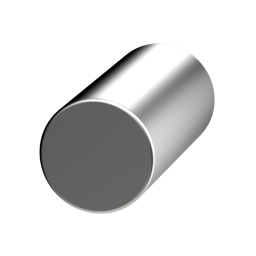
Round Bar
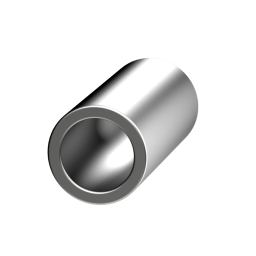
Round Tube
Sheet
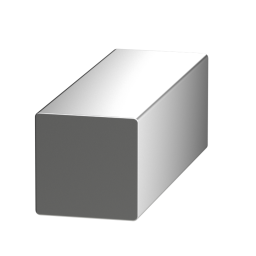
Square Bar
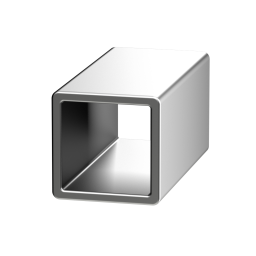
Square Tube
Standard Beam
Strip
Tee
Additional Data
Specifications
330,5592,5716,B366,B511,B512,B536,B546,B710,B739,1.4333,1.4864,N08330Chemical Elements
| Carbon | 0.08 max |
| Chromium | 17 - 20 |
| Copper | 1 max |
| Iron | Balance |
| Lead | 0.005 max |
| Manganese | 2 max |
| Nickel | 34 - 37 |
| Phosphorus | 0.03 max |
| Silicon | 0.75 - 1.5 |
| Sulphur | 0.03 max |
| Tin | 0.025 max |
Physical Properties
Density: 0.289lb/in³
Specific Gravity: 7.99
Specific Heat: 0.11BTU/lb·°F
Mechanical Properties
Modulus of Elasticity – Tension: 28.5MSI
Relative Magnetic Permeability: 1.02μᵣ
Thermal Conductivity
| Condition | Temperature | Conductivity |
|---|---|---|
| Annealed | 70 °F | 8.6 BTU/hr·ft·°F |
| Annealed | 800 °F | 13.5 BTU/hr·ft·°F |
| Annealed | 1600 °F | 19.8 BTU/hr·ft·°F |
Thermal Expansion
| Condition | Min | Max | Expansion Coefficient |
|---|---|---|---|
| Annealed | 70 °F | 200 °F | 8.3 μin/in·°F |
| Annealed | 70 °F | 1500 °F | 9.7 μin/in·°F |
| Annealed | 70 °F | 1600 °F | 9.8 μin/in·°F |
| Annealed | 70 °F | 1700 °F | 9.9 μin/in·°F |
| Annealed | 70 °F | 1800 °F | 10 μin/in·°F |