Stainless
Stainless 405
Annealing Procedure
Soak at 1200-1400 F(649-760 C), air cool.
Applications
Commonly used for annealing boxes, steam nozzles, quenching racks, partitions and other fabrications that cannot be annealed after welding.
Forgeability
Soak at 1500-1600 F(817-871 C) and then quickly increase to 1900-2050 F(1038-1121 C). Do not remain at this temperature as the result will be excessive grain growth. Do not work below 1500 F(816C). After forging, air cool and anneal.
Formability
405 can be easily spun, drawn and formed using common forming procedures.
Hardening Procedure
While this alloy does not respond appreciably to heat treatment, soaking at 1800-1850 F(982-1010 C) followed by oil quenching will increase mechanical properties.
Machinability
Soft and ductile, 405 can be easily machined using most standard practices. Experienced machinists comment that 405 machines similarly to 4130 alloy steel.
Principle Design Features
405 is a 12% chromium steel designed to be used in the as-welded condition. Unlike other 12% chromium steels, it is not subject to a great deal of hardening through air cooling form high temperatures.
Weldability
405 can be welded using shielded fusion and resistance techniques. Oxyacetylene welding is not recommended. Use 405 Cb electrodes that contain columbium rather than aluminum to control hardening. Post weld annealing will maximize ductility.
Known Forms
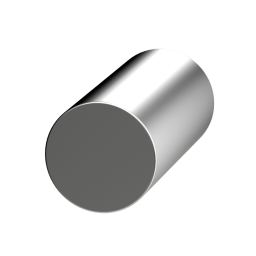
Angle
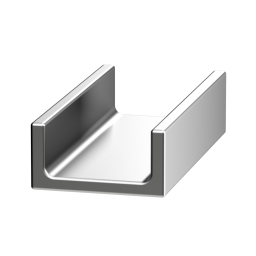
Channel
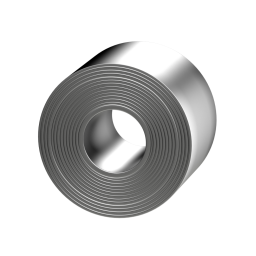
Coil
Disc
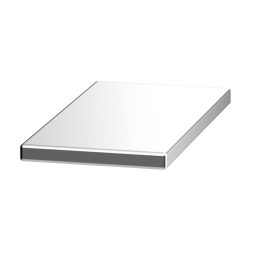
Flat Bar
Foil
Hexagon Bar
Hollow Bar
Pipe
Plate
Precision Ground Bar

Rectangle Tube
Ring
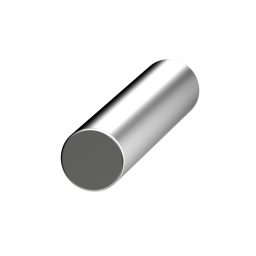
Rod
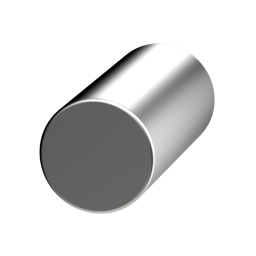
Round Bar
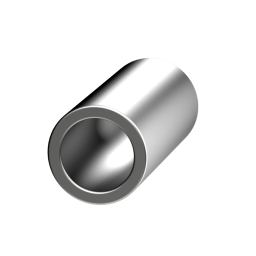
Round Tube
Sheet
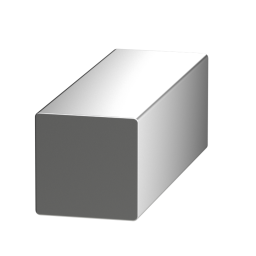
Square Bar
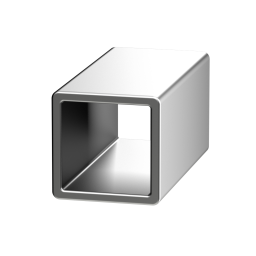
Square Tube
Standard Beam
Strip
Tee
Additional Data
Specifications
405,A176,A240,A268,A276,A473,A479,A511,A580,1.4002,S763,S40500Chemical Elements
| Aluminum | 0.1 - 0.3 |
| Carbon | 0.08 max |
| Chromium | 11.5 - 14.5 |
| Iron | Balance |
| Manganese | 1 max |
| Nickel | 0.5 max |
| Phosphorus | 0.04 max |
| Silicon | 1 max |
| Sulphur | 0.03 max |
Physical Properties
Density: 0.279lb/in³
Specific Gravity: 7.72
Specific Heat: 0.11BTU/lb·°F
Mechanical Properties
Modulus of Elasticity – Tension: 29MSI
Thermal Conductivity: 34.6667BTU/hr·ft·°F
Thermal Conductivity
| Condition | Temperature | Conductivity |
|---|---|---|
| Annealed | 212 °F | 18.7 BTU/hr·ft·°F |
Thermal Expansion
| Condition | Min | Max | Expansion Coefficient |
|---|---|---|---|
| Annealed | 32 °F | 212 °F | 5.4 μin/in·°F |
| Annealed | 32 °F | 392 °F | 5.7 μin/in·°F |
| Annealed | 32 °F | 572 °F | 6 μin/in·°F |
| Annealed | 32 °F | 752 °F | 6.3 μin/in·°F |
| Annealed | 32 °F | 932 °F | 6.6 μin/in·°F |
| Annealed | 32 °F | 1112 °F | 6.7 μin/in·°F |
| Annealed | 32 °F | 1292 °F | 6.8 μin/in·°F |
| Annealed | 32 °F | 1472 °F | 7.1 μin/in·°F |
| Annealed | 32 °F | 1652 °F | 7.2 μin/in·°F |