Stainless
Stainless 410S
Annealing Procedure
1200-1400 F (649-760 C), followed by air cooling.
Cold Workability
Readily cold formed using most of the common practices.
Hardening Procedure
This alloy does not respond to hardening by heat treatment.
Hot Workability
2000-2200 F (1093-1204 C) is the proper hot work range. Do not work this material below 1650 F (899 C).
Machinability
Tough, draggy chips with heavy build-up. While this alloy can be machined in the annealed condition, it tends to perform better in the cold drawn or heat treated condition.
Principle Design Features
410S is a non-heat treatable version of 410 stainless. It possesses the same characteristics as 410 including moderate corrosion resistance and good strength in the annealed condition.
Weldability
Most common methods of welding can be successfully employed with this alloy. To reduce the chance of cracking, it is advisable to preheat the workpiece to 350-400 F (177-204 C). Post-weld annealing is recommended to reattain maximum ductility. Filler metal, when required, should be AWS E/ER410S.
Known Forms
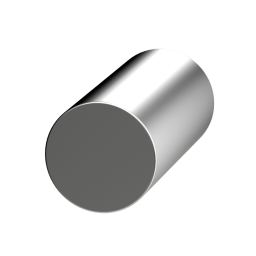
Angle
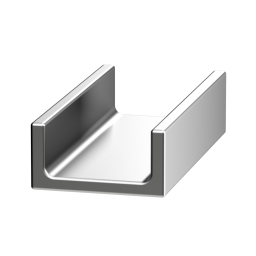
Channel
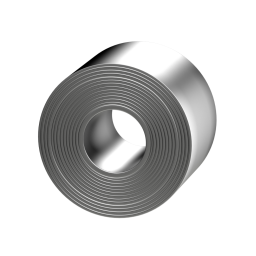
Coil
Disc
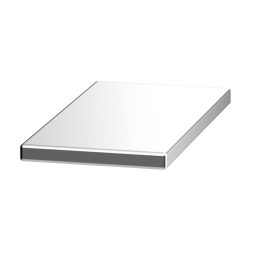
Flat Bar
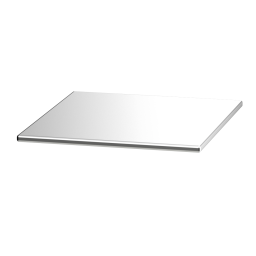
Foil
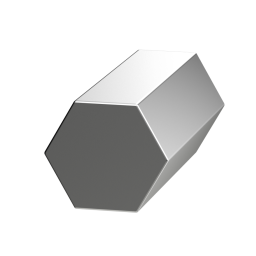
Hexagon Bar
Hollow Bar
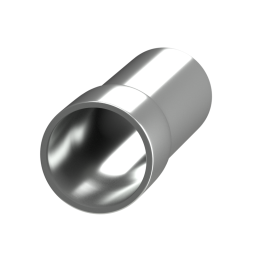
Pipe
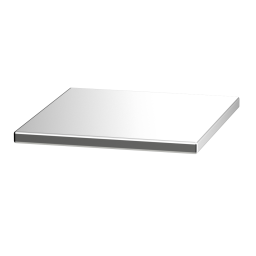
Plate
Precision Ground Bar
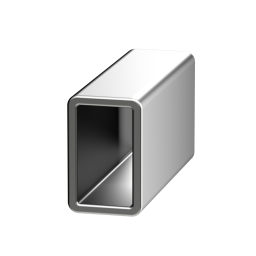
Rectangle Tube
Ring
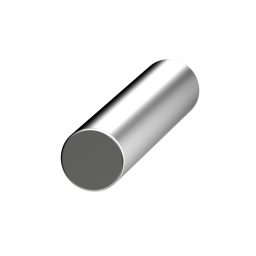
Rod
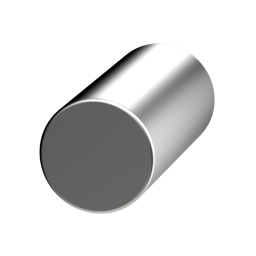
Round Bar
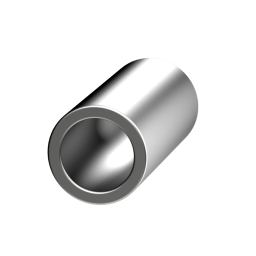
Round Tube
Sheet
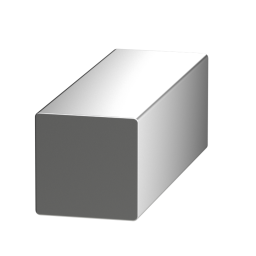
Square Bar
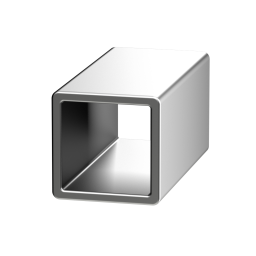
Square Tube
Standard Beam
Strip
Tee
Additional Data
Specifications
A240,A473,1.0400,1.4001,1.4034,S41008Chemical Elements
| Carbon | 0.08 max |
| Chromium | 11.5 - 13.5 |
| Iron | Balance |
| Manganese | 1 max |
| Nickel | 0.6 max |
| Phosphorus | 0.04 max |
| Silicon | 1 max |
| Sulphur | 0.03 max |
Physical Properties
Density: 0.28lb/in³
Electrical Resistivity: 342µΩ·cm
Melting Point: 2790°F
Specific Gravity: 7.7
Specific Heat: 0.11BTU/lb·°F
Mechanical Properties
Modulus of Elasticity – Tension: 29MSI
Thermal Conductivity
| Condition | Temperature | Conductivity |
|---|---|---|
| Annealed | 70 °F | 17.3 BTU/hr·ft·°F |