Stainless
Stainless 446
Annealing Procedure
Soak at 1500 F and water quench. Do not exceed 1650 F at any time. Slow cooling below 1200 F will result in the loss of ductility.
Applications
Boiler baffles, furnace parts, X-ray tube bases, oil burner components, kiln linings, glass molds, annealing boxes and industrial mufflers.
Cold Workability
Due to its elevated chromium content, 446 is more difficult than other stainless steels to bend, draw, spin and weld.
Forgeability
Begin forging at 2100 F and finish at 1600 F. The final 10% of work should be performed below 1600 F for optimum grain refinement and room temperature embrittlement.
Hardening Procedure
This alloy does not respond to heat treatment.
Hot Workability
2000-2150 F. Last 10% of work should be performed below 1600 F for grain refinement.
Machinability
Slow speeds and positive feeds combined with rigid mounts and sharp tooling surfaces optimize machining 446.
Principle Design Features
A ferritic, non-heat treatable stainless steel that offers good resistance to high temperature corrosion and oxidation.
Weldability
Most common welding methods can be successfully employed with this alloy. Type 308 welding material may be used, but will not display scaling resistance equal to the base metal. Consideration must be given to the differences in coefficient of thermal expansion of base and weld metal. Oxyacetylene welding is not recommended.
Known Forms
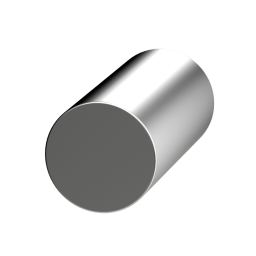
Angle
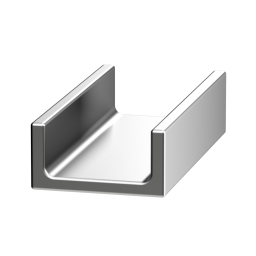
Channel
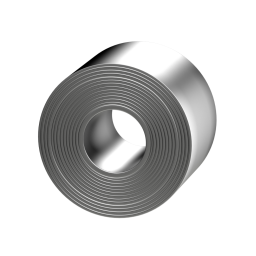
Coil
Disc
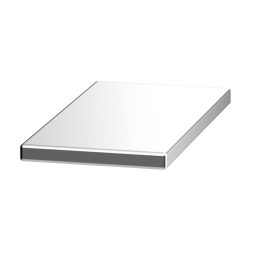
Flat Bar
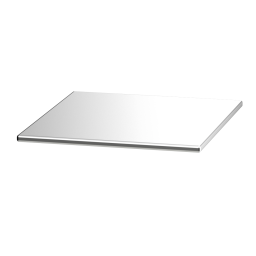
Foil
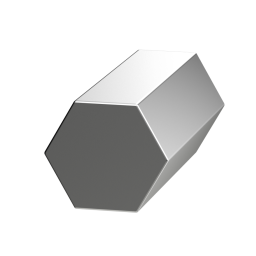
Hexagon Bar
Hollow Bar
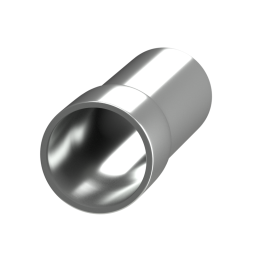
Pipe
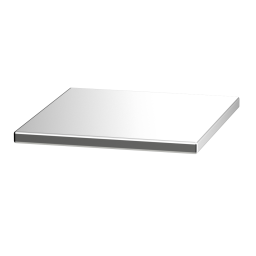
Plate
Precision Ground Bar

Rectangle Tube
Ring
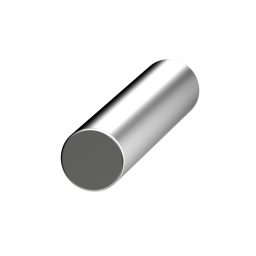
Rod
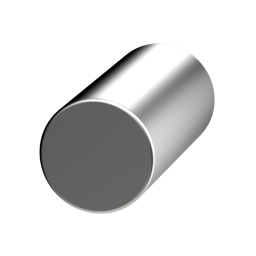
Round Bar
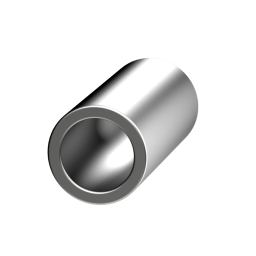
Round Tube
Sheet
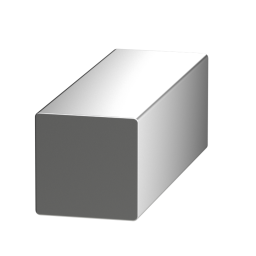
Square Bar
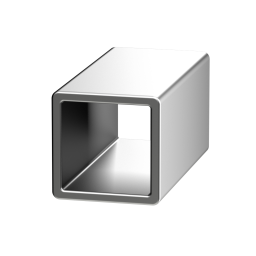
Square Tube
Standard Beam
Strip
Tee
Additional Data
Specifications
446,A176,A268,A276,A314,A473,A511,A815,1.4762,S763,S766,S44600Chemical Elements
| Carbon | 0.2 max |
| Chromium | 23 - 27 |
| Iron | Balance |
| Manganese | 1.5 max |
| Nitrogen | 0.25 max |
| Phosphorus | 0.04 max |
| Silicon | 1 max |
| Sulphur | 0.03 max |
Physical Properties
Density: 0.27lb/in³
Electrical Resistivity: 402µΩ·cm
Melting Point: 2750°F
Specific Gravity: 7.45
Specific Heat: 0.12BTU/lb·°F
Mechanical Properties
Modulus of Elasticity – Tension: 29MSI
Thermal Conductivity
| Condition | Temperature | Conductivity |
|---|---|---|
| Annealed | 212 °F | 14.5 BTU/hr·ft·°F |
Thermal Expansion
| Condition | Min | Max | Expansion Coefficient |
|---|---|---|---|
| Annealed | 70 °F | 212 °F | 5.7 μin/in·°F |
| Annealed | 70 °F | 1472 °F | 6.5 μin/in·°F |
| Annealed | 70 °F | 1832 °F | 7.4 μin/in·°F |
Mechanical Test Data
| Form | Strip |
| Condition | Cold Reduced 10% |
| Temperature | 70°F |
| Elongation | 20% |
| Tensile Strength | 87 KSI |
| Yield Strength | 74 KSI |
| Form | Strip |
| Condition | Cold Reduced 20% |
| Temperature | 70°F |
| Elongation | 4% |
| Tensile Strength | 106 KSI |
| Yield Strength | 102 KSI |
| Form | Strip |
| Condition | Cold Reduced 40% |
| Temperature | 70°F |
| Elongation | 3% |
| Tensile Strength | 124 KSI |
| Yield Strength | 121 KSI |
| Form | Strip |
| Condition | Cold Reduced 60% |
| Temperature | 70°F |
| Elongation | 2% |
| Tensile Strength | 135 KSI |
| Yield Strength | 130 KSI |