Stainless
Stainless AL6XN
Annealing Procedure
Solution annealing is performed by heating to a minimum of 2025–2050°F (1110–1120°C) followed by rapid cooling (water quench or rapid air cool). This treatment dissolves precipitated phases, restores the fully austenitic microstructure, and maximizes corrosion resistance and ductility. Slow cooling must be avoided as it promotes sigma phase and carbide precipitation, which degrade both corrosion resistance and mechanical properties.
Applications
AL6XN is widely used in seawater desalination systems, flue gas desulfurization (FGD) systems, chemical process vessels and pipelines, seawater heat exchangers, offshore oil and gas platforms, pulp and paper industry, food and beverage processing, pharmaceutical and biotech manufacturing, air pollution control equipment, and power generation. It is also accepted for use per ASME-BPE and is FDA- and NSF-approved for food and water contact applications.
Corrosion Resistance
AL6XN exhibits outstanding resistance to chloride pitting, crevice corrosion, and stress corrosion cracking. It provides practical immunity to chloride stress corrosion cracking in sodium chloride environments, and resists corrosion from a broad range of acids and salt solutions in both hot and cold environments. Performance is superior to 304, 316L, and all duplex grades in highly aggressive chloride-bearing environments, and is cost-competitive with more expensive nickel-base alloys such as Hastelloy C-276 and titanium alloys in many service conditions.
Formability
AL6XN has good cold formability and can be formed by bending, drawing, and pressing using standard methods. Higher forming forces are required compared to standard 300-series stainless steels due to its elevated strength. Bending over a sharp male die should be avoided as it may cause cracking. After significant cold deformation, stress relief or full solution annealing followed by water quenching is recommended to restore mechanical and corrosion properties. Slow cooling after annealing reduces corrosion resistance and must be avoided.
Hot Workability
AL6XN can be hot formed in the temperature range of 1830–2300°F (1000–1260°C). Hot forming should be followed by solution annealing at or above 2025°F (1110°C) and rapid quenching to restore full corrosion resistance and prevent sigma phase formation.
Machinability
AL6XN can be machined using standard equipment, but requires sharp tools, rigid machine setups, and adequate cooling due to its elevated work-hardening rate and high strength. Feed rates should be kept sufficiently high to ensure the cutting edge penetrates below any work-hardened surface zone. Sulfur-chlorinated petroleum oil lubricants are recommended. All cutting fluid residues must be removed prior to welding, annealing, or placing in corrosive service.
Other Comments
AL6XN is a registered trademark of ATI Properties, Inc. (formerly Allegheny Technologies Incorporated). It is equivalent to UNS N08367 and the European designation W.Nr. 1.4529 / EN 1.4529. Competing trade names for the same UNS N08367 alloy include SSC-6MO (Sandmeyer Steel) and INCOLOY 25-6HN. The alloy is approved for use under NACE MR0175 for hydrogen sulfide-containing petroleum and natural gas service and the Norsok M-DP-001 standard for Norwegian offshore oil platforms.
Other Physical Properties
AL6XN is non-magnetic in the annealed condition and remains essentially non-magnetic after cold working or welding. The alloy has a DIN/EN Werkstoff number of 1.4529. The scaling temperature (maximum continuous service temperature in air) is approximately 1000°F (538°C).
Principle Design Features
AL6XN (UNS N08367) is a low-carbon, high-purity, nitrogen-bearing super-austenitic stainless steel. It contains approximately 24% nickel, 21% chromium, 6.2% molybdenum, and 0.22% nitrogen. The high molybdenum and nitrogen content provides a Pitting Resistance Equivalent Number (PREN) of approximately 47.6, far exceeding standard 300-series stainless steels. The nitrogen addition increases tensile strength above that of common austenitic stainless steels while retaining high ductility and impact strength. ASME allowable stresses are up to 40% higher than for 316L stainless steel.
Weldability
AL6XN is readily weldable using standard austenitic stainless steel techniques including GTAW, GMAW, SMAW, FCAW, and SAW. The low carbon and high nitrogen content minimizes carbide and secondary phase precipitation during welding, allowing as-welded assemblies to be placed in service. Overmatched filler metals with at least 9% molybdenum (such as ERNiCrMo-3 / Alloy 625) are recommended to compensate for chemical segregation in the weld zone. Low heat input practices are preferred to avoid hot cracking.
Known Forms
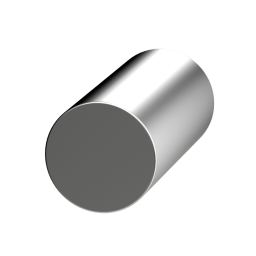
Billet
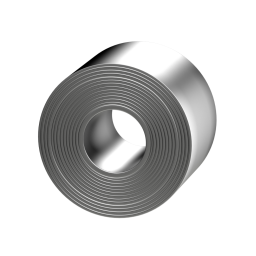
Coil
Fitting
Flange
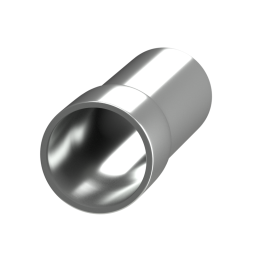
Pipe
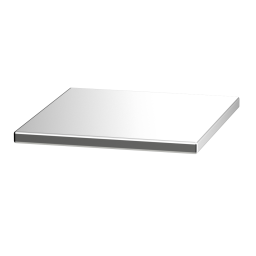
Plate
Ring
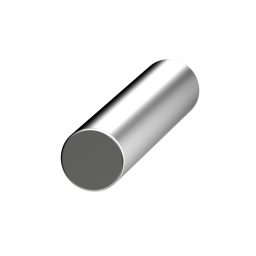
Rod
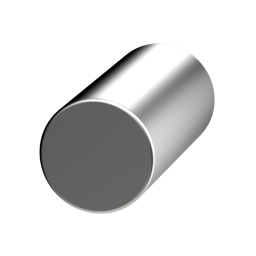
Round Bar
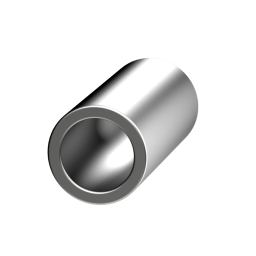
Round Tube
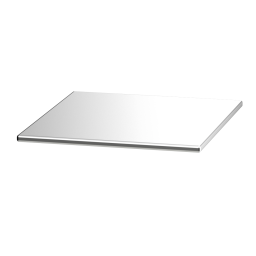
Sheet
Strip
Wire Round
Additional Data
Specifications
A182,A240,A249,A312,A479,B366,B462,B472,B564,B675,B676,B688,B691,B804,N08367,SB-564,SB-688,SA-240,SB-675,SA-312,SB-676,SA-249,SB-691,SA-479,SB-462,SA-182,SB-366Chemical Elements
| Carbon | 0.03 max |
| Chromium | 20 - 22 |
| Copper | 0.75 max |
| Iron | Balance |
| Manganese | 2 max |
| Molybdenum | 6 - 7 |
| Nickel | 23.5 - 25.5 |
| Nitrogen | 0.18 - 0.25 |
| Phosphorus | 0.04 max |
| Silicon | 1 max |
| Sulfur | 0.03 max |
Physical Properties
Density: 0.291lb/in³
Electrical Resistivity: 89µΩ·cm
Melting Point: 2410°F
Modulus of Elasticity: 28MSI
Specific Heat: 0.11BTU/lb·°F
Thermal Conductivity
| Condition | Temperature | Conductivity |
|---|---|---|
| Solution Annealed | 212 °F | 6.8 BTU/hr·ft·°F |
Thermal Expansion
| Condition | Min | Max | Expansion Coefficient |
|---|---|---|---|
| Solution Annealed | 68 °F | 212 °F | 8.9 μin/in·°F |
Mechanical Test Data
| Form | Plate |
| Condition | Solution Annealed |
| Temperature | 70°F |
| Elongation | 30% |
| Rockwell Hardness | B88 |
| Tensile Strength | 95 KSI |
| Yield Strength | 45 KSI |
| Form | Sheet |
| Condition | Solution Annealed |
| Temperature | 70°F |
| Elongation | 30% |
| Rockwell Hardness | B88 |
| Tensile Strength | 95 KSI |
| Yield Strength | 45 KSI |
| Form | Strip |
| Condition | Solution Annealed |
| Temperature | 70°F |
| Elongation | 30% |
| Rockwell Hardness | B88 |
| Tensile Strength | 95 KSI |
| Yield Strength | 45 KSI |