Stainless
Stainless AM 350 (tm)
Aging Procedure
Double Aging-- Soak material at 1350-1400 F(732-760 C) for 3 hours, cool to room temperature and then soak at 825-875 F(440-468 C) for 3 hours and air cool.
Annealing Procedure
Soak at 1850-1950 F, rapid quench.
Applications
Generally employed in applications under 1000 F where a combination of corrosion resistance and strength are required such as industrial cutters and knives and a variety of valve and gas turbine components.
Cold Workability
Best results are found in working the material in the annealed condition where its characteristic are not unlike 300 series stainless steels. Radical deformation will be limited by its high work hardening rate and the formation of martensite. Material in the hardened condition will tolerate only mild forming / deformation.
Hardening Procedure
Either sub zero or double aging can be employed in hardening this material. Before hardening by either method the material should be prepared by rapid cooling from 1710 F(932 C).
Hot Workability
Hot work should commence after heating to 2150 F(1177 C). Finish at 1800 F(982 C).
Machinability
Despite what some machinists refer to as "gummy" chips and a rather high work hardening rate, this alloy can be successfully machined using practices employed on high strength stainless steels. Sharp tooling, slow speeds, positive feeds and adequate lubricant is recommended.
Principle Design Features
This alloy is a heat treatable austenitic/ martensitic alloy (depending on heat treatment) that brings together the strength of heat treatable martensitic grades with the corrosion resistance of some of the chromium nickel austenitic grades.
Tempering Procedure
Sub Zero Cooling--Soak material for 3-4 hours at -100 F(-73 C) followed by tempering at 850 F(454 C),{for maximum strength}, or 1000 F(538 C),{for maximum corrosion resistance and toughness} for 3-4 hours.
Weldability
This alloy can be successfully welded using all common methods with the notable exception of Oxyacetylene. While preheating the weld piece is not required, it is recommended that the material be annealed after welding to reattain maximum properties. For best strength at elevated temperature a filler metal should be chosen that is of similar chemistry.
Known Forms
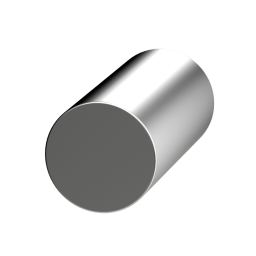
Angle
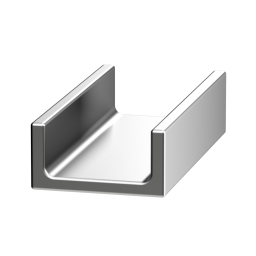
Channel
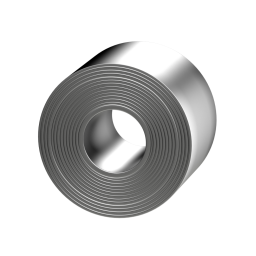
Coil
Disc
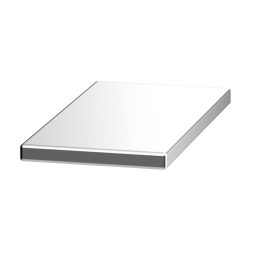
Flat Bar
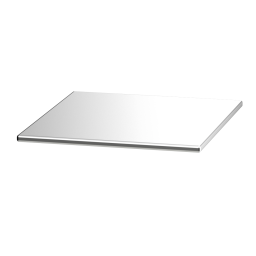
Foil
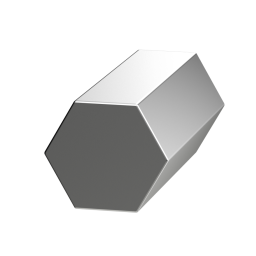
Hexagon Bar
Hollow Bar
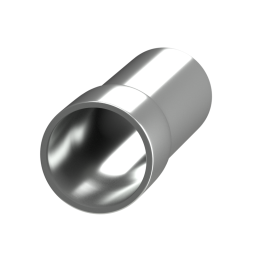
Pipe
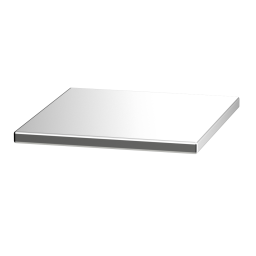
Plate
Precision Ground Bar
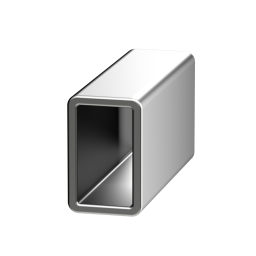
Rectangle Tube
Ring
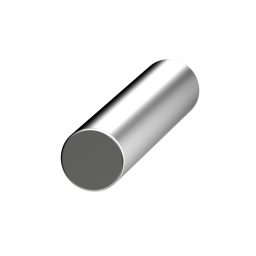
Rod
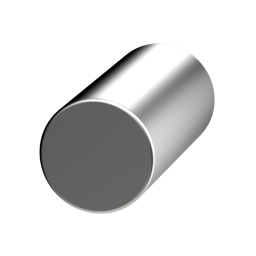
Round Bar
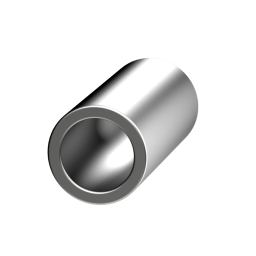
Round Tube
Sheet
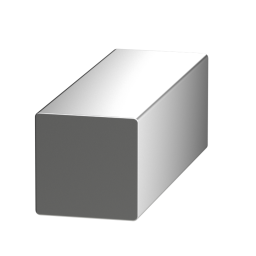
Square Bar
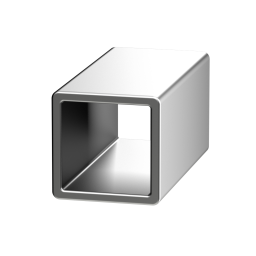
Square Tube
Standard Beam
Strip
Tee
Additional Data
Specifications
633,5546,5548,5554,A579,A693,S-8840,S35000Chemical Elements
| Carbon | 0.07 - 0.11 |
| Chromium | 16 - 17 |
| Iron | Balance |
| Manganese | 0.5 - 1.25 |
| Molybdenum | 2.5 - 3.25 |
| Nickel | 4 - 5 |
| Nitrogen | 0.07 - 0.13 |
| Phosphorus | 0.04 max |
| Silicon | 0.5 max |
| Sulphur | 0.03 max |
Physical Properties
Density: 0.287lb/in³
Electrical Resistivity: 474µΩ·cm
Specific Gravity: 7.92
Specific Heat: 0.11BTU/lb·°F
Mechanical Properties
Modulus of Elasticity – Tension: 29.4MSI