Steel
Steel 1020
Aging Procedure
Not applicable.
Annealing Procedure
A full anneal is done at 1600 to 1800 F followed by slow furnace cooling. This will give a tensile strength of about 65 ksi. A stress relief anneal may be done at 1000 F.
Applications
1020 steel is used for simple structural application such as cold headed bolts. It is often used in the case hardened condition.
Cold Workability
1020 steel is readily cold worked by all conventional methods. A stress relief anneal may be needed after extensive cold work.
Forgeability
Forge at 2300 down to 1800 F.
Formability
Formability is good by all conventional methods as the ductility of 1020 is good.
Hardening Procedure
1020 steel hardens by cold working an by heat treatment, quenching and tempering.
Heat Treatability
1020 may be hardened by heating to 1500 - 1600 F and then water quenching. It should then be tempered. More often it is used as case hardened by carburizing . The cost of doing any heat treatment to such a low carbon steel often precludes doing so for the modest return in mechanical properties obtained.
Hot Workability
Hot work in the range of 900 to 1200 F.
Machinability
Machinability is good at 65% compared to 1112 carbon steel as 100% baseline.
Principle Design Features
1020 is one of the very commonly used plain carbon steels. It has a nominal carbon content of 0.20% with approximately 0.50% manganese. It is a good combination of strength and ductility and may be hardened or carburized.
Tempering Procedure
Temper, following heat treatment and quenching, at 600 to 1000 F depending upon strength level desired. A 1000 F temper gives a tensile strength of 90 ksi.
Weldability
Readily weldable by all of the standard methods.
Known Forms
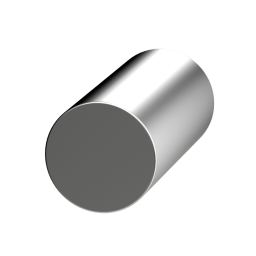
Angle
Billet
Bolt
Cee
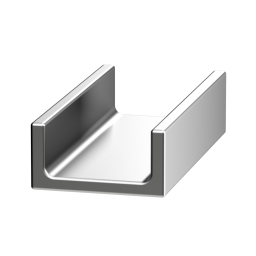
Channel
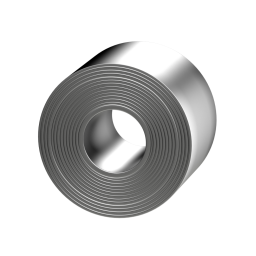
Coil
Decking
Disc
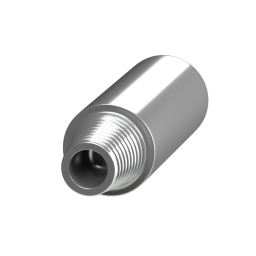
Drill Rod
Expanded Sheet
Fitting
Flange
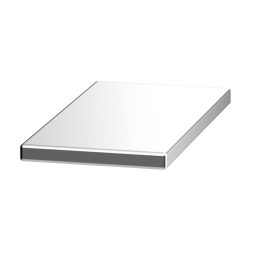
Flat Bar
Grating
H-Beam
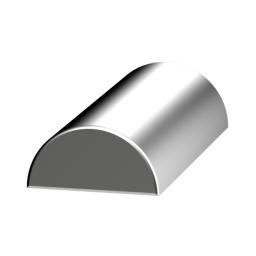
Half Round
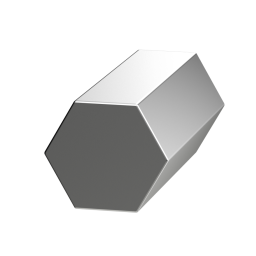
Hexagon Bar
Hollow Bar
Nut
Octagon Bar
Perforated Sheet
Piling
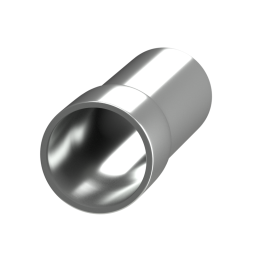
Pipe
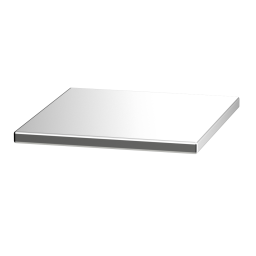
Plate
Precision Ground Bar
Rail
Rebar
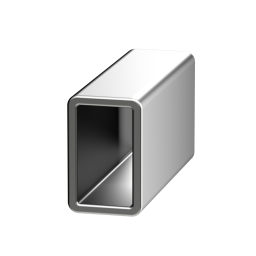
Rectangle Tube
Ring
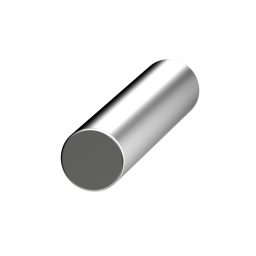
Rod
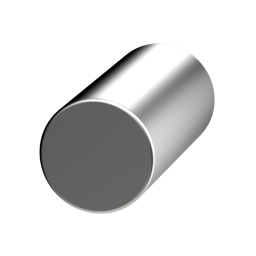
Round Bar
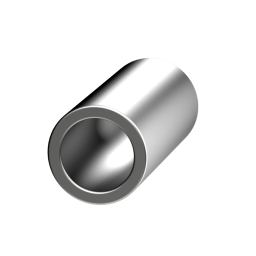
Round Tube
Screw
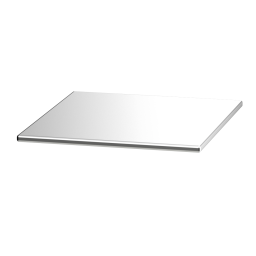
Sheet
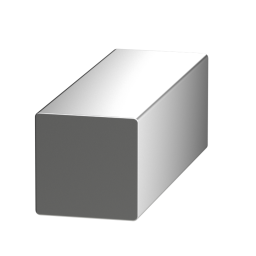
Square Bar
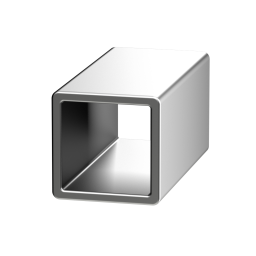
Square Tube
Standard Beam
Strip
Tee
Threaded Rod
Treadplate
Valve
Washer
Wide Beam
Wire Flat
Wire Round
Wire Square
Zee
Additional Data
Specifications
5032,5046,5054,A29 (1020),A510 (1020),A512 (1020, MT 1020),A513 (MT 1020),A519 (1020, MT 1020),A544 (1020),A575 (M1020),A576 (1020),A635 (1020),A659 (1020),A787 (MT 1020),A794 (1020),A827,A830,S-11310 (CS 1020),S-16788,S-7952,T-3520,J1397 (1020),J403 (1020),J412 (1020),G10200Chemical Elements
| Carbon | 0.17 - 0.23 |
| Iron | Balance |
| Manganese | 0.3 - 0.6 |
| Phosphorus | 0.04 max |
| Sulphur | 0.05 max |
Physical Properties
Density: 0.284lb/in³
Melting Point: 2760°F
Poissons Ratio: 0.3
Specific Gravity: 7.86
Specific Heat: 0.107BTU/lb·°F
Mechanical Properties
Modulus of Elasticity – Tension: 30MSI
Modulus of Elasticity – Torsion: 11MSI
Thermal Conductivity: 30BTU/hr·ft·°F
Thermal Expansion: 6.7µin/in·°F
Mechanical Test Data
| Form | Round Bar |
| Condition | Cold Drawn |
| Temperature | 68°F |
| Brinell Hardness | 126 HB |
| Elongation | 24% |
| Reduction of Area | 54% |
| Rockwell Hardness | B79 |
| Tensile Strength | 64 KSI |
| Yield Strength | 54 KSI |
| Form | Round Bar |
| Condition | Hot Rolled |
| Temperature | 68°F |
| Brinell Hardness | 137 HB |
| Elongation | 25% |
| Reduction of Area | 50% |
| Rockwell Hardness | B76 |
| Tensile Strength | 55 KSI |
| Yield Strength | 30 KSI |