Steel
Steel 300M
Aging Procedure
Not applicable to this alloy.
Annealing Procedure
Anneal at 1550 F and slow furnace cool at a rate of less than 50 F per hour down to 600 F. From there it may be air cooled.
Applications
Applications for 300M steel are those that require strength in the 290 - 300 ksi range, such as aircraft landing gear, high strength bolts and airframe parts.
Cold Workability
In the annealed or normalized condition the alloy has good ductility and can be readily cold worked by conventional methods.
Forgeability
No data. The alloy is forgeable - contact the supplier for details.
Formability
Formability by conventional methods is good in the annealed condition. The alloy behaves much like AISI 4340 steel.
Hardening Procedure
300M hardens from cold working and by heat treatment. See "Heat Treatment" and "Tempering".
Heat Treatability
300M must be normalized at 1700 F before hardening. After the normalizing treatment the alloy is hardened by heating to 1600 F and oil quenching. Tempering is then done last.
Hot Workability
No data. Heat input can cause this alloy to air harden. Contact the alloy supplier for information as to the advisability of hot working.
Machinability
Machining is best accomplished with the alloy in the normalized or normalized and tempered condition. Final machining to finish tolerances is done by grinding with care due the hardness of the heat treated alloy (Rockwell C 55). It is important to do a stress relief anneal at 550 F after finish grinding.
Other Comments
300M may be joined by Nicer brazing, copper brazing and silver brazing.
Principle Design Features
300M is a low alloy, vacuum melted, steel of very high strength. Essentially it is a modified AISI 4340 steel with silicon, vanadium and slightly greater carbon and molybdenum content than 4340. 300M has a very good combination of strength (280 to 305 ksi), toughness, fatigue strength and good ductility. It is a through hardening alloy.
Tempering Procedure
Temper at 600 F to give a nominal 300 ksi strength.
Weldability
300M can be welded by fusion methods or by flash resistance welding. Approved procedures must be used for fusion welding, including pre and post-heating practice, because the alloy will air harden due to heat input from welding. Following welding it is essential to re-normalize or re-normalize and temper prior to the final hardening heat treatment.
Known Forms
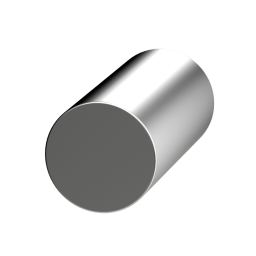
Angle
Billet
Cee
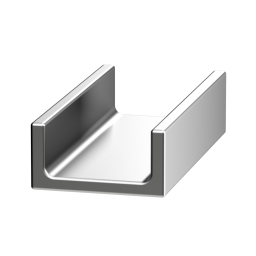
Channel
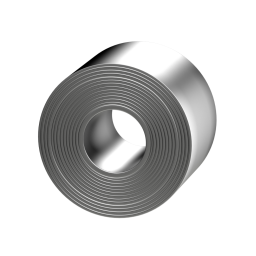
Coil
Disc
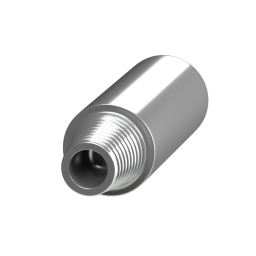
Drill Rod
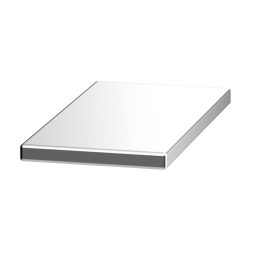
Flat Bar
H-Beam
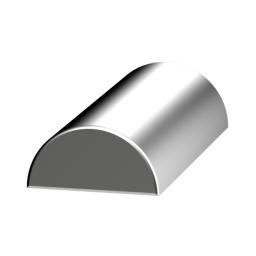
Half Round
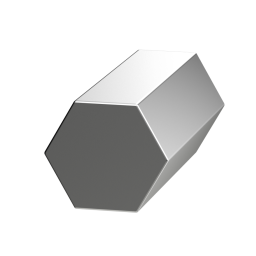
Hexagon Bar
Hollow Bar
Octagon Bar
Piling
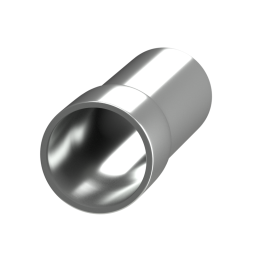
Pipe
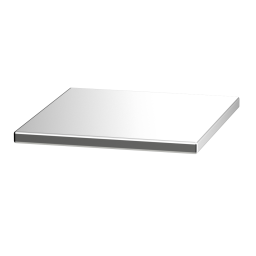
Plate
Precision Ground Bar
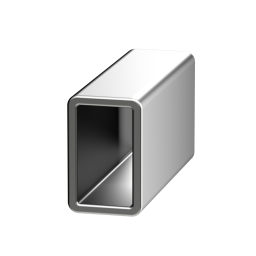
Rectangle Tube
Ring
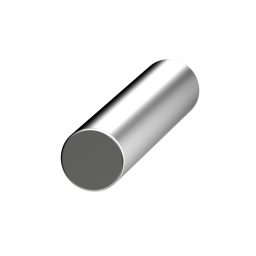
Rod
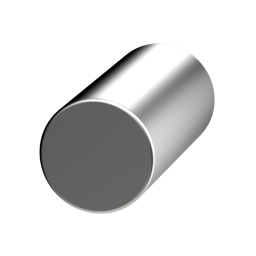
Round Bar
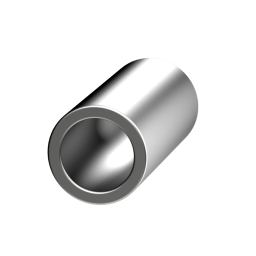
Round Tube
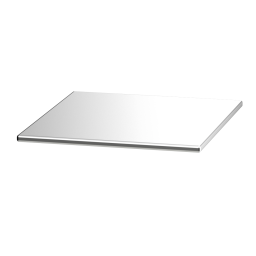
Sheet
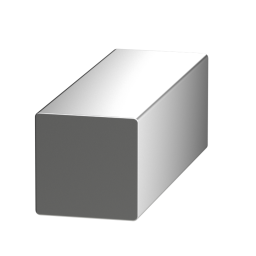
Square Bar
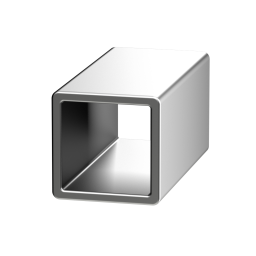
Square Tube
Standard Beam
Strip
Tee
Treadplate
Wide Beam
Zee
Additional Data
Specifications
6417,6419,A579 (32),A646 (300M-8),S-8844 (3),S-8844 Class 2,K44220Chemical Elements
| Carbon | 0.38 - 0.46 |
| Chromium | 0.7 - 0.95 |
| Iron | Balance |
| Manganese | 0.6 - 0.9 |
| Molybdenum | 0.3 - 0.65 |
| Nickel | 1.65 - 2 |
| Phosphorus | 0.01 max |
| Silicon | 1.45 - 1.8 |
| Sulphur | 0.01 max |
| Vanadium | 0.05 nom |
Physical Properties
Density: 0.283lb/in³
Melting Point: 2590°F
Specific Gravity: 7.83
Specific Heat: 0.116BTU/lb·°F
Mechanical Properties
Modulus of Elasticity – Tension: 29MSI
Thermal Conductivity: 1.75BTU/hr·ft·°F
Thermal Expansion: 6.6µin/in·°F