Steel
Steel 4118
Annealing Procedure
Anneal AISI 4118 by heating to approximately 860–900°C (1580–1652°F) and then slowly cooling in the furnace. Full annealing produces a soft, ductile microstructure suitable for subsequent machining or cold working operations.
Applications
AISI 4118 is widely used in the automotive, aerospace, oil and gas, construction, and general engineering industries. Typical applications include gears and gear shafts, cog wheels, bolts and fasteners (bolts, studs, screws), shafts, axles, crankshafts, connecting rods, drive shafts, cam components, valve stems, pistons, high-pressure pipes, spindles, pins, bushings, and wear-resistant parts for heavy-duty equipment. Its combination of high strength, good hardenability, toughness, and wear resistance makes it well suited for carburized parts and open-die steel forgings for general engineering purposes.
Cold Workability
AISI 4118 exhibits good cold straining plasticity and can be cold worked using conventional methods in the annealed condition.
Corrosion Resistance
AISI 4118 offers moderate atmospheric corrosion resistance attributable to its chromium content. However, the chromium level (0.40–0.60%) is not sufficient to provide the corrosion resistance of stainless steels. The steel is intended for use in non-corrosive media and at temperatures below approximately 250°C (480°F). Protective coatings or surface treatments are recommended in corrosive environments.
Forgeability
AISI 4118 is suitable for open-die and closed-die forging for general engineering purposes. The hot working temperature range is approximately 850–1100°C (1562–2012°F).
Hardening Procedure
Harden AISI 4118 by heating to 850–880°C (1562–1616°F) followed by oil or water quenching. Hardness after quenching is typically 39–47 HRC.
Heat Treatability
AISI 4118 responds well to heat treatment. It can be normalized, annealed, hardened by quenching, and tempered. The steel is also well suited to case hardening by carburization, with the case providing high wear resistance while the core retains toughness. Normalizing temperature is approximately 860–900°C (1580–1652°F).
Hot Workability
AISI 4118 can be hot worked over a temperature range of approximately 850–1100°C (1562–2012°F). Standard hot forming and open-die forging practices for low-alloy steels are applicable.
Machinability
AISI 4118 has good machinability, particularly in the annealed condition. The relatively low carbon content and controlled alloy additions contribute to excellent machining and cutting characteristics. Cold straining plasticity is also good. Conventional machining methods including turning, drilling, boring, milling, and tapping are all applicable.
Principle Design Features
AISI 4118 is a low-carbon chromium-molybdenum (Cr-Mo) alloy steel belonging to the SAE 41xx series. It offers a balanced combination of strength, toughness, wear resistance, and hardenability. The chromium content (0.40–0.60%) improves hardenability and mechanical properties, while molybdenum (0.08–0.15%) enhances strength and reduces temper brittleness. The comparatively low carbon content (0.18–0.23%) provides good weldability and cold workability while still allowing case hardening by carburization. The steel exhibits no temper brittleness and has higher quench-hardening ability than plain carbon steels of equivalent carbon content.
Tempering Procedure
After quench hardening, temper AISI 4118 at 595–700°C (1103–1292°F) to achieve the desired balance of hardness and toughness. The specific tempering temperature should be selected based on the required mechanical properties.
Weldability
The weldability of AISI 4118 is very good. Its low carbon content minimizes the tendency for cold crack formation. The steel can be welded using gas tungsten arc welding (GTAW) or shielded metal arc welding (SMAW) methods. Preheating prior to welding is recommended to minimize the risk of cracking due to thermal shock during cooling. Post-weld stress relief heat treatment may be beneficial in certain applications.
Known Forms
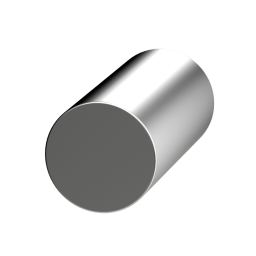
Angle
Billet
Cee
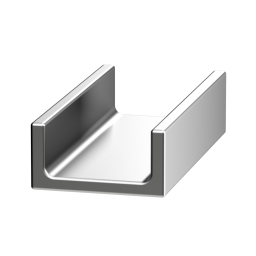
Channel
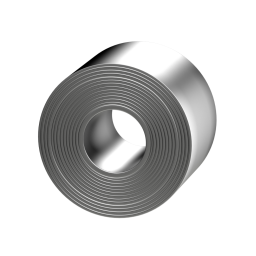
Coil
Disc
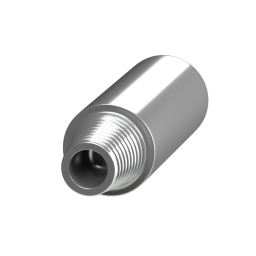
Drill Rod
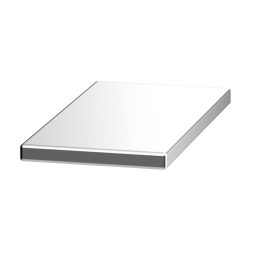
Flat Bar
H-Beam
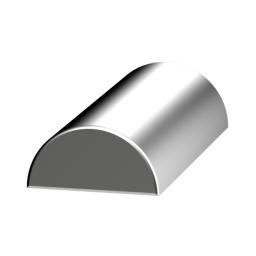
Half Round
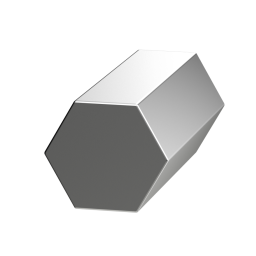
Hexagon Bar
Hollow Bar
Octagon Bar
Piling
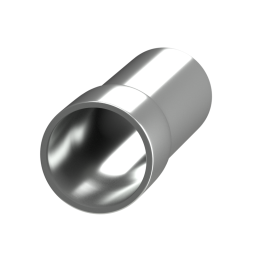
Pipe
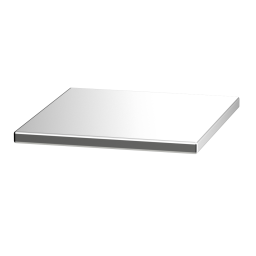
Plate
Precision Ground Bar
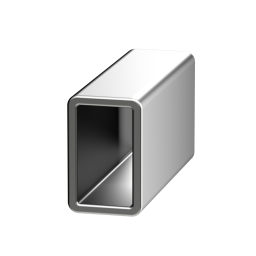
Rectangle Tube
Ring
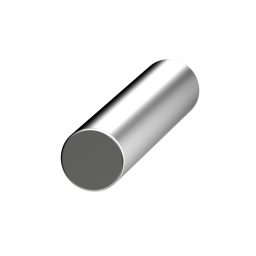
Rod
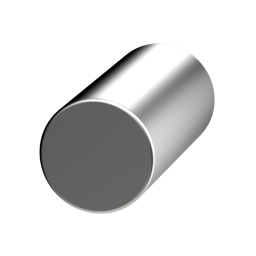
Round Bar
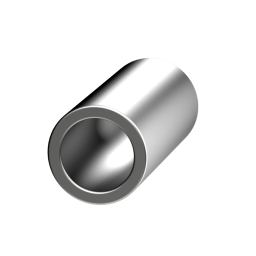
Round Tube
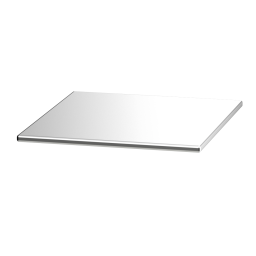
Sheet
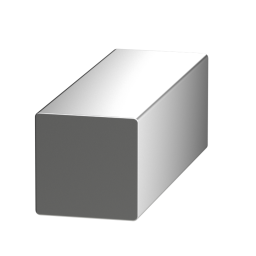
Square Bar
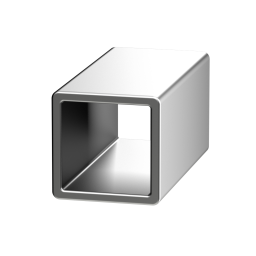
Square Tube
Standard Beam
Strip
Tee
Treadplate
Wide Beam
Zee
Additional Data
Specifications
A29,A322,A331,A506,A507,A513,A519,A752,A829,J1397,J404,J412,G41180,A505Chemical Elements
| Carbon | 0.18 - 0.23 |
| Chromium | 0.4 - 0.6 |
| Iron | Balance |
| Manganese | 0.7 - 0.9 |
| Molybdenum | 0.08 - 0.15 |
| Phosphorus | 0.03 max |
| Silicon | 0.15 - 0.35 |
| Sulphur | 0.04 max |
Physical Properties
Density: 0.283lb/in³
Melting Point: 2590°F
Modulus of Elasticity: 27MSI
Specific Heat: 0.11BTU/lb·°F
Thermal Conductivity
| Condition | Temperature | Conductivity |
|---|---|---|
| Annealed | 70 °F | 11.6 BTU/hr·ft·°F |
Mechanical Test Data
| Form | |
| Condition | Annealed |
| Temperature | 70°F |
| Brinell Hardness | 150 HB |
| Elongation | 23% |
| Tensile Strength | 73 KSI |
| Yield Strength | 47 KSI |