Steel
Steel 4130
Aging Procedure
Not applicable to this alloy.
Annealing Procedure
4130 (and most of the other low alloy steels) may be annealed at 1550 F for a time long enough to allow thorough heating of the section size. It should then be cooled in the furnace at a rate of less than 50 F per hour down to 900 F, followed by air cooling from 900 F.
Applications
Typical applications for 4130 low alloy steel include. structural use such as aircraft engine mounts and welded tubing applications.
Cold Workability
Cold working by conventional methods is readily accomplished on this alloy.
Forgeability
Forge at 2200 F maximum down to 1750 F.
Formability
Formability is best in the annealed condition for which the ductility is very good, Bend radii of 1t on annealed sheet material may be made.
Hardening Procedure
Hardening is accomplished by heat treatment or by cold working -- see "Heat Treatment".
Heat Treatability
Heating at 1600 F followed by an oil quench will harden the 4130 alloy. For best results a normalizing pre-hardening heat treatment may be used at 1650 to 1700 F followed by the 1600 F soak and oil quench.
Hot Workability
4130 in the annealed condition has excellent ductility. Thus it is usually not necessary to do hot working to form parts. If hot working is needed it can be done in the range of 2000 F to 1500 F.
Machinability
This alloy is readily machined by conventional methods. Machinability is best with the alloy in the normalized and tempered condition. Although the alloy may be machined in the fully heat treated condition, machinability becomes more difficult with increasing strength (hardness) of the alloy.
Other Comments
The 4130 alloy is a through hardening alloy and should not be case hardened.
Principle Design Features
AISI 4130 is a low alloy steel containing molybdenum and chromium as strengthening agents. The carbon content is nominally 0.30% and with this relatively low carbon content the alloy is excellent from the fusion weldability standpoint. The alloy can be hardened by heat treatment.
Tempering Procedure
Tempering is done to restore some of the ductility that may be lost after the hardening heat treatment and quench. Alloy 4130 is tempered at between 750 F and 1050 F, depending upon the strength level desired. The lower the tempering temperature the greater the strength.
Weldability
4130 alloy is noted for its weldability by all of the commercial methods.
Known Forms
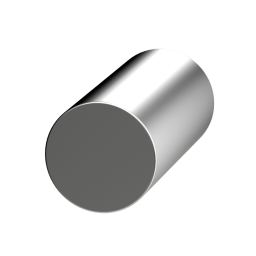
Angle
Billet
Cee
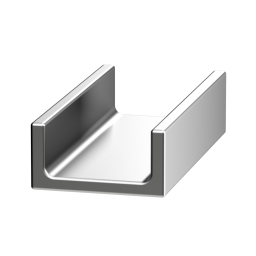
Channel
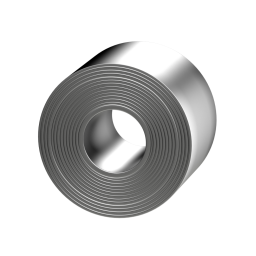
Coil
Disc
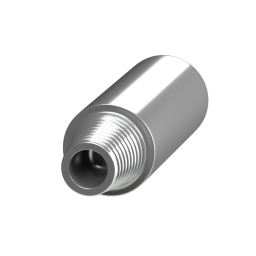
Drill Rod
Fitting
Flange
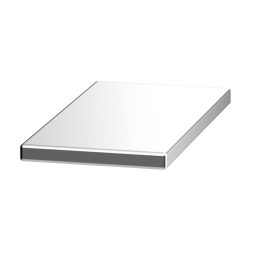
Flat Bar
H-Beam
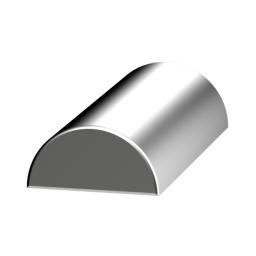
Half Round
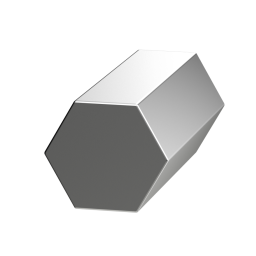
Hexagon Bar
Hollow Bar
Octagon Bar
Piling
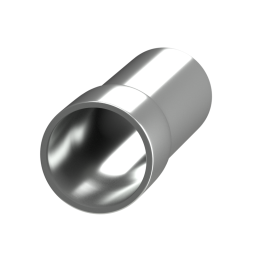
Pipe
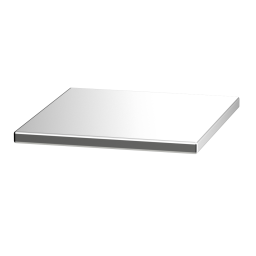
Plate
Precision Ground Bar
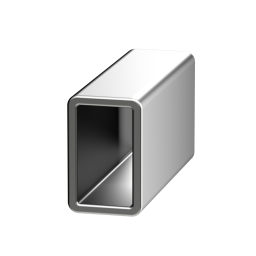
Rectangle Tube
Ring
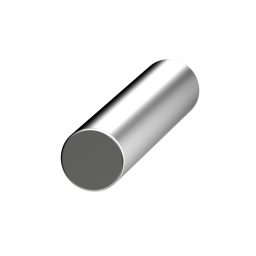
Rod
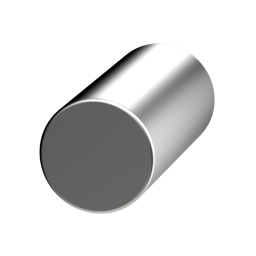
Round Bar
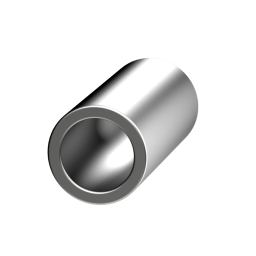
Round Tube
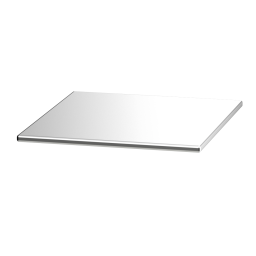
Sheet
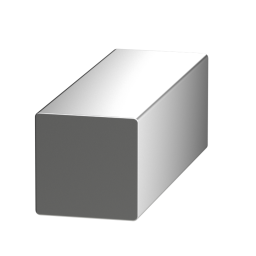
Square Bar
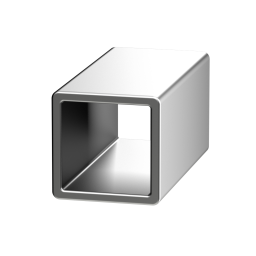
Square Tube
Standard Beam
Strip
Tee
Treadplate
Valve
Wide Beam
Wire Flat
Wire Round
Wire Square
Zee
Additional Data
Specifications
4130,6348,6350,6351,6360,6361,6362,6370,6371,6373,6374,6528,7496,A108,A29,A322,A331,A506,A507,A513,A519,A646,A752,A829,S-18729,S-6758,J1397,J404,J412,G41300Chemical Elements
| Carbon | 0.28 - 0.33 |
| Chromium | 0.8 - 1.1 |
| Manganese | 0.7 - 0.9 |
| Molybdenum | 0.15 - 0.25 |
| Phosphorus | 0.035 max |
| Silicon | 0.15 - 0.35 |
| Sulphur | 0.04 max |
Physical Properties
Density: 0.283lb/in³
Melting Point: 2610°F
Specific Gravity: 7.8
Specific Heat: 0.114BTU/lb·°F
Mechanical Properties
Modulus of Elasticity – Tension: 29MSI
Thermal Conductivity: 1.8583BTU/hr·ft·°F
Thermal Expansion: 7µin/in·°F
Thermal Expansion
| Condition | Min | Max | Expansion Coefficient |
|---|---|---|---|
| Annealed | 68 °F | 700 °F | 2.5 μin/in·°F |