Steel
Steel 4330
Aging Procedure
Not applicable to this alloy.
Annealing Procedure
A full anneal may be done at 1500 to 1650 F followed by slow (furnace) cooling at a rate not in excess of 50 F per hour down to 600 F. From 600 F the alloy may then be air cooled.
Applications
Applications are those that require a good combination of strength and impact resistance, such as gears, aircraft landing gear, axles or shafts for power transmission.
Cold Workability
Cold working capability is good and conventional methods may be used,
Forgeability
The alloy is forgeable in the range of 2200 F to 1800 F.
Formability
The formability is good, especially for sheet material in the annealed condition in which state it can be bent or formed by spinning. Bend radii should not be sharper than a 3t bend.
Hardening Procedure
The alloy harden by means of heat treatment and tempering. See "Heat Treatment" and "Tempering"
Heat Treatability
Hardening of 4330 alloy is done by heating to 1525 F and then oil quenching. If the alloy is to be heat treated to strength levels of 200 ksi, or greater, then it should first be normalized at 1650 F before being heat treated and quenched for strengthening.
Hot Workability
Hot working may be done on this alloy, although usually not necessary because the alloy has good cold forming characteristics. Consult the alloy supplier for hot working information.
Machinability
Machining is best accomplished with the alloy in the annealed, normalized and tempered condition. The alloy is much more difficult to machine in the strengthened (hardened) condition. Machinability in the high strength conditions can be only 15% to 25% that of the alloy in the annealed state.
Principle Design Features
AISI 4330 is a heat treatable steel alloy (for high strength) containing chromium, nickel and molybdenum. Carbon content is in the 0.30% range and in the heat treated condition the alloy has good toughness and fatigue strength as well as good strength.
Tempering Procedure
Tempering, following the Heat Treatment for hardening, varies depending upon the strength level desired. For the 260 - 280 ksi level use a tempering temperature of 425 to 500 F. For the lower strength 125 to 200 ksi level use 850 to 1175 F for tempering. At strength levels in the 220 to 260 ksi range tempering should NOT be done as it can result in degradation of impact strength.
Weldability
4330 may be welded by conventional methods. Preheat and post heat treatments should be used in accord with the recommended weld procedure for this alloy. The alloy may also be successfully joined by brazing.
Known Forms
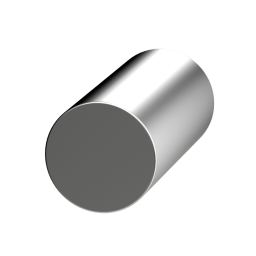
Angle
Billet
Cee
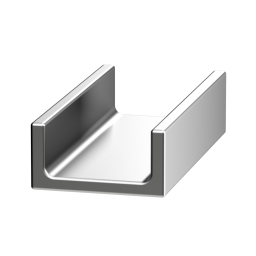
Channel
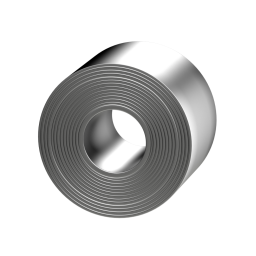
Coil
Disc
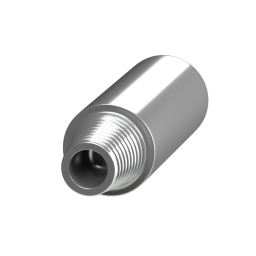
Drill Rod
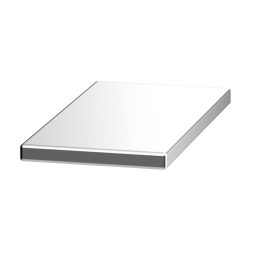
Flat Bar
H-Beam
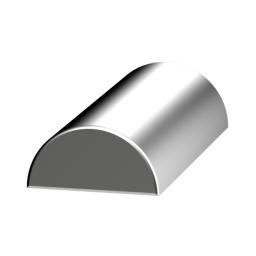
Half Round
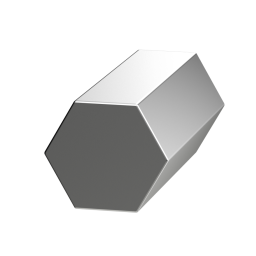
Hexagon Bar
Hollow Bar
Octagon Bar
Piling
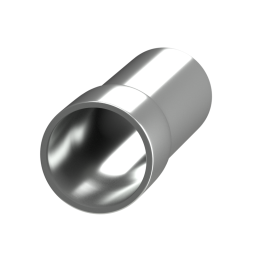
Pipe
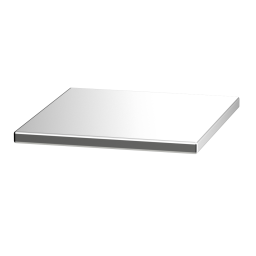
Plate
Precision Ground Bar
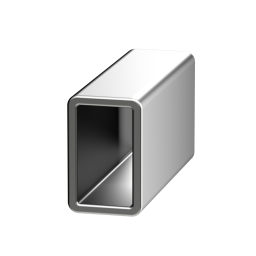
Rectangle Tube
Ring
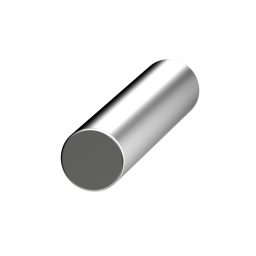
Rod
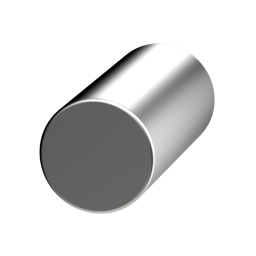
Round Bar
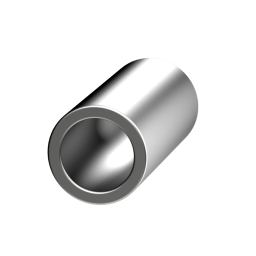
Round Tube
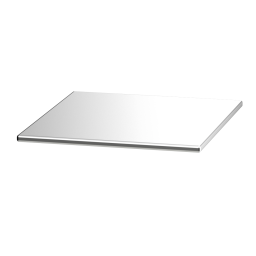
Sheet
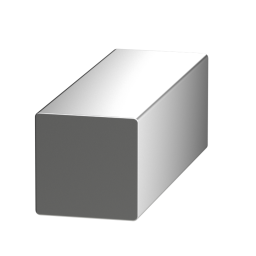
Square Bar
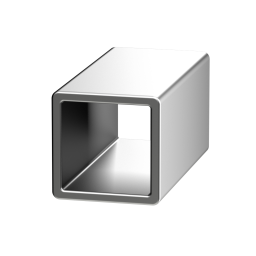
Square Tube
Standard Beam
Strip
Tee
Treadplate
Wide Beam
Zee
Additional Data
Physical Properties
Density: 0.28lb/in³
Melting Point: 2600°F
Specific Gravity: 7.8
Specific Heat: 0.116BTU/lb·°F
Mechanical Properties
Modulus of Elasticity – Tension: 29MSI
Thermal Conductivity: 1.75BTU/hr·ft·°F
Thermal Expansion: 6.6µin/in·°F