Steel
Steel 8620
Aging Procedure
Not applicable to this alloy.
Annealing Procedure
AISI 8620 may be given a full anneal at 1550 F and slow cooling at not more than 50 F per hour down to 850 F. From there it may be air cooled.
Applications
In the carburized condition this alloy is used for gears, ring gears, shafts and crankshafts.
Cold Workability
The alloy may be cold worked in the annealed condition by conventional methods. Cold working, as with machining, should be done to as close a tolerance as possible before heat treatment or carburizing.
Forgeability
The alloy may be forged at 2200 F down to 1800 F prior to the hardening heat treatment or carburizing.
Formability
Forming characteristics of 8620 alloy are good in the annealed condition.
Hardening Procedure
Hardening is done by oil quench from 1675 F. See "Heat Treatment". Carburizing is accomplished at the same 1650 to 1700 F range in a carburizing "pack" or environment, followed by oil quench for thin sections or a furnace cool for heavier (over 3/4") sections. Following carburizing of heavy sections a reheat at 1575 F will enhance both case and core properties of the alloy.
Heat Treatability
This alloy may be hardened by heating to 1500 F followed by a water quench. Carburize at 1650 to 1700 F in an appropriate carburizing medium and oil quench to harden. Improved carburized case and core properties can be obtained by furnace cooling from carburizing at 1650 - 1700 F and then reheating to 1575 F.
Hot Workability
Hot working may be accomplished prior to hardening or carburizing. Consult the alloy supplier for information as to temperatures.
Machinability
Machining is done prior to carburizing to within as close a tolerance as possible. Finish machining, after heat treatment and/or carburizing, should be at a minimum so as not to impair the hardened case of the part. Machining may be done by conventional means prior to heat treatment - after carburizing machining is usually limited to grinding.
Other Comments
This alloy is typically used for carburized parts where a hardened case is desired for wear resistance.
Principle Design Features
AISI 8620 is a hardenable chromium, molybdenum, nickel low alloy steel often used for carburizing to develop a case-hardened part. This case-hardening will result in good wear characteristics.
Tempering Procedure
Tempering of carburized parts is done at 250 to 300 F and this will result in the alloy having a core strength of approximately 135 ksi minimum with Rockwell C case hardness of 90. Tempering of heat treated and water quenched parts (not carburized) is done at 400 F to 1300 F with greater hardness the lower the tempering temperature.
Weldability
The alloy may be welded by conventional methods, usually gas or arc welding. Preheating at 400 F is beneficial and subsequent heating after welding is recommended - consult the approved weld procedure for the method used.
Known Forms
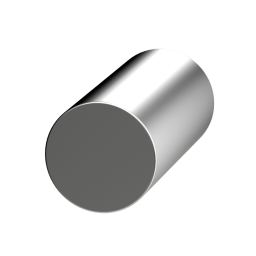
Angle
Billet
Bolt
Cee
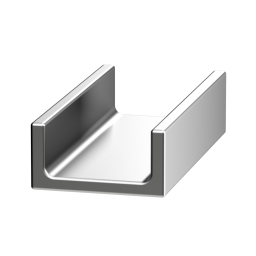
Channel
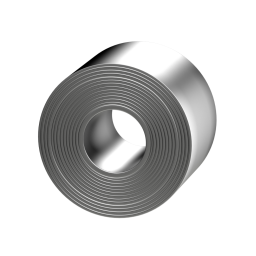
Coil
Disc
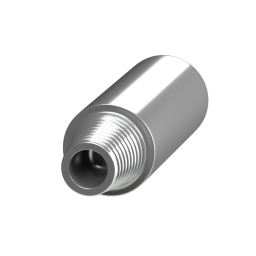
Drill Rod
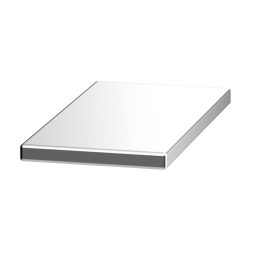
Flat Bar
H-Beam
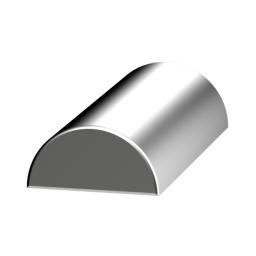
Half Round
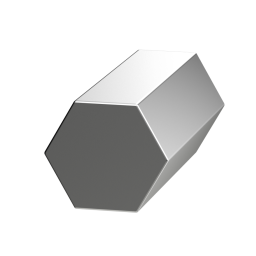
Hexagon Bar
Hollow Bar
Nut
Octagon Bar
Piling
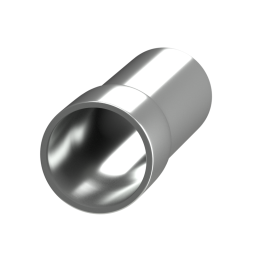
Pipe
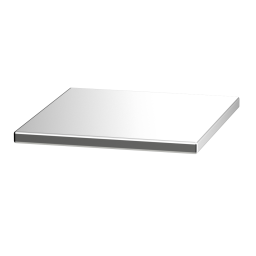
Plate
Powder
Precision Ground Bar
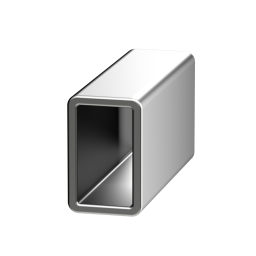
Rectangle Tube
Ring
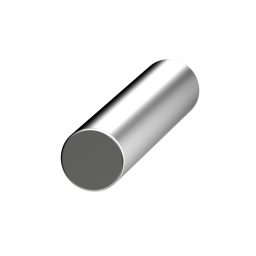
Rod
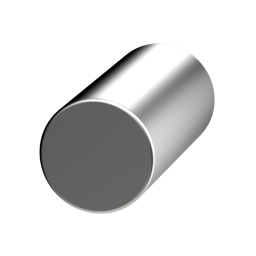
Round Bar
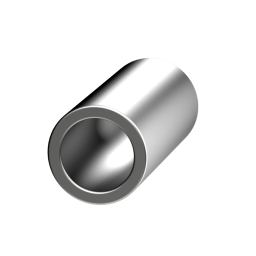
Round Tube
Screw
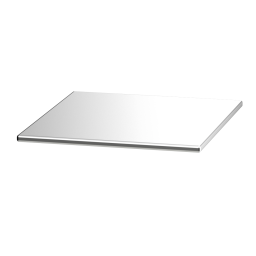
Sheet
Specialty Form
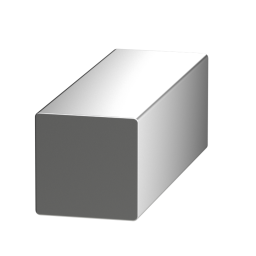
Square Bar
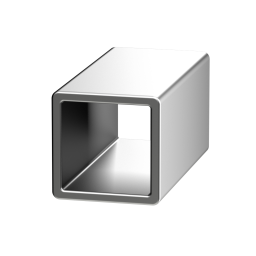
Square Tube
Standard Beam
Strip
Tee
Threaded Rod
Treadplate
Washer
Wide Beam
Wire Round
Zee
Additional Data
Specifications
8620,6274,6276,6277,6375,A29 (8620),A322 (8620),A331 (8620),A506 (8620),A507 (8620),A513,A519 (8620),A646 (8620-4),A752 (8620),A829,S-8690,J1397 (8620),J404 (8620),G86200Chemical Elements
| Carbon | 0.18 - 0.23 |
| Chromium | 0.4 - 0.6 |
| Manganese | 0.7 - 0.9 |
| Molybdenum | 0.15 - 0.25 |
| Nickel | 0.4 - 0.7 |
| Phosphorus | 0.035 max |
| Silicon | 0.15 - 0.35 |
| Sulphur | 0.04 max |
Physical Properties
Density: 0.283lb/in³
Melting Point: 2600°F
Specific Gravity: 7.8
Specific Heat: 0.1BTU/lb·°F
Mechanical Properties
Modulus of Elasticity – Tension: 31MSI
Thermal Conductivity: 2.1667BTU/hr·ft·°F
Thermal Expansion: 6.6µin/in·°F