Steel
Steel HY80
Aging Procedure
Not applicable to this alloy.
Annealing Procedure
A stress relief anneal may be done at 1200 F for 1 hour per inch of thickness, followed by furnace cooling at a rate not in excess of 200 F per hour down to 500 F. From there it can be air cooled.
Applications
This alloy is best known for use in shipbuilding for welded hull plates and structural use.
Cold Workability
HY-80 has very good ductility and is readily cold worked by conventional means. Bend radii of 2t for material up to one inch thick and 3t for material thickness' of one to two inches thick are recommended.
Forgeability
Because the alloy is supplied in the heat treated and tempered condition it should not be subsequently reheated for forging.
Formability
HY-80 may be readily cold or hot formed by conventional bending, or forming, processes. It does exhibit more springback than plain carbon steel so allowance must be made for that when bend forming.
Hardening Procedure
The alloy will harden by cold working. It is supplied in the hardened and tempered condition and should be used that way.
Heat Treatability
HY-80 is supplied in the quenched and tempered condition so a heat treatment as such is not required. It may be given a stress relief anneal, if deemed necessary, at 1200 F for one hour per inch of thickness followed by slow furnace cooling (not exceeding 200 F per hour) to 500 F, followed by air cooling.
Hot Workability
Hot working, if necessary, may be done in the range of 600 to 200 F.
Machinability
HY-80 steel is readily machined when in the quenched and tempered condition. It machines with the same feeds and speeds as for other low alloy steels with Rockwell C 20 hardness.
Other Mechanical Properties
HY-80 is noted for notch toughness. Charpy V-notch values are 50 ft lb. for material 1/2" to 1-1/2" thick and 30 ft lb. for over 1-1/2" thick.
Principle Design Features
HY-80 is a high yield strength (minimum of 80 ksi) , low carbon, low alloy steel with nickel, molybdenum and chromium. It has excellent weldability and notch toughness along with good ductility even in welded sections.
Tempering Procedure
HY-80 is supplied in the tempered condition of 80 ksi minimum yield strength. No additional tempering should be attempted.
Weldability
Weldments of HY-80 are noted for good ductility, notch toughness and strength. It is best welded using the metal-arc process with low hydrogen electrodes of Type E-10018 or E-11018. Use approved weld procedures so as to not apply too much heat input per inch of weld bead, which would otherwise cause degradation of notch toughness. Electrodes should be warmed before use to drive off any moisture to avoid hydrogen pick-up in the weld. Preheating is not required, except for very heavy section thickness welds or heavily constrained welds. Post-heating is not required but a stress relief anneal, after welding of sections of 1-1/2" thick or greater, is desirable. However the alloy may be used in the as-welded condition.
Known Forms
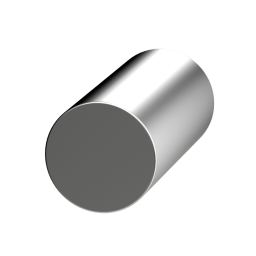
Angle
Billet
Cee
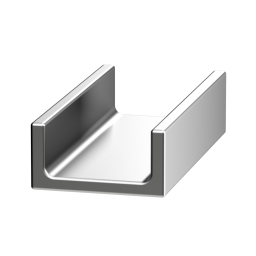
Channel
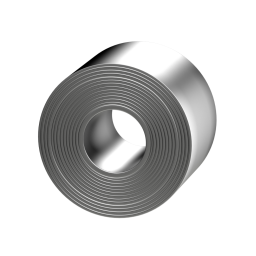
Coil
Disc
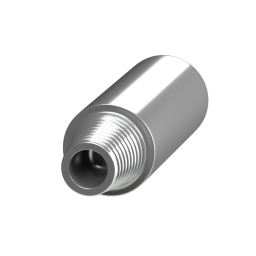
Drill Rod
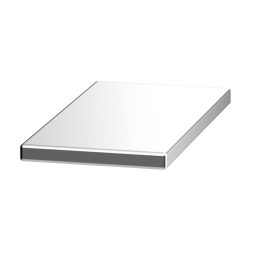
Flat Bar
H-Beam
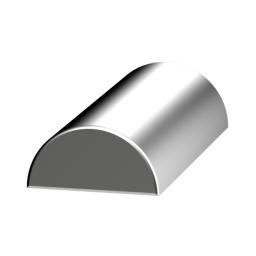
Half Round
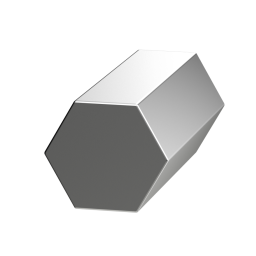
Hexagon Bar
Hollow Bar
Octagon Bar
Piling
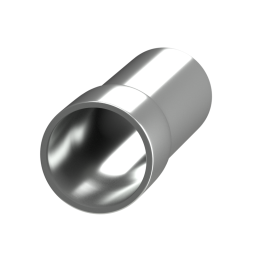
Pipe
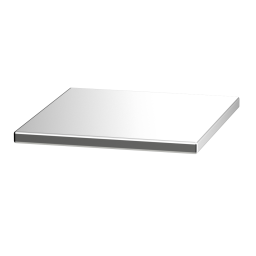
Plate
Precision Ground Bar
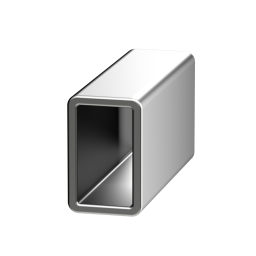
Rectangle Tube
Ring
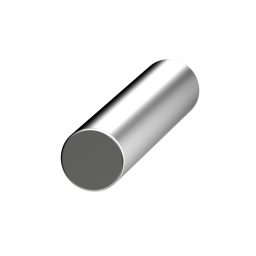
Rod
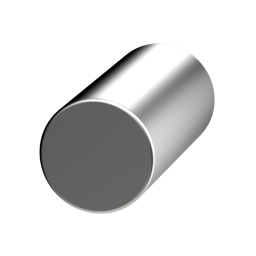
Round Bar
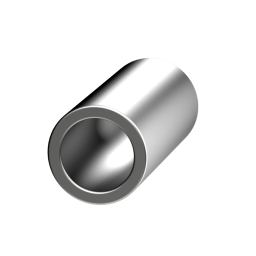
Round Tube
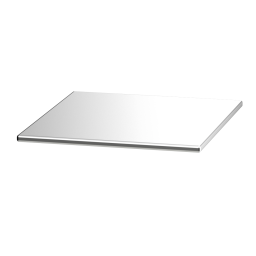
Sheet
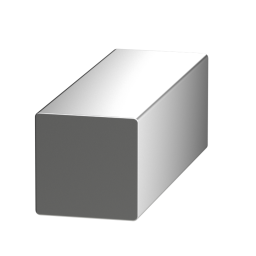
Square Bar
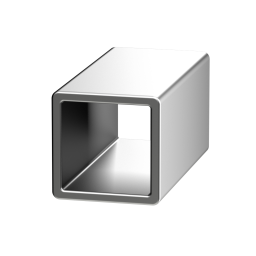
Square Tube
Standard Beam
Strip
Tee
Treadplate
Wide Beam
Zee
Additional Data
Specifications
S-16216,S-21952Physical Properties
Density: 0.28lb/in³
Melting Point: 2595°F
Specific Gravity: 7.83
Specific Heat: 0.11BTU/lb·°F
Mechanical Properties
Modulus of Elasticity – Tension: 29MSI
Modulus of Elasticity – Torsion: 12MSI
Thermal Conductivity: 22BTU/hr·ft·°F
Thermal Expansion: 6.3µin/in·°F