Titanium
Titanium 10-2-3
Aging Procedure
482-510 C(900-950 F) for 8 hours, Air Cool.
Annealing Procedure
For sections up to 1/2", hold at 1500 F for 30 minutes.
Applications
Often used in near-net shape forging, 10-2-3 is most commonly used in high strength airframe components.
Cold Workability
The cold working characteristics of this alloy are similar to those found in austenitic stainless steels. In multiple forming operations, intermediate stress relieving is recommended to offset the alloy's tendency to work harden. Post-work annealing is recommended to re-attain maximum performance characteristics.
Forgeability
Rough forge and finish at 871-927 C (1600-1700 F).
Formability
This alloy can be hot or cold formed and will exhibit characteristics equivalent to those found in a 1/8 to 1/4 hard austenitic stainless steel.
Heat Treatability
Solution treat at 752-774 C(1385-1425 F) for 1 hour, water quench.
Hot Workability
Hot forming will reduce both the springback and required forming forces, and will increase the overall ductility of the material.
Machinability
As a family, titanium and its alloys have developed a mystique as a nightmare to machine. This is simply not the case. Experienced operators have compared its characteristics to those found in 316 stainless steel. Recommended practice includes high coolant flow(to offset the material's low thermal conductivity), slow speeds and relatively high feed rates. Tooling should be tungsten carbide designations C1-C4 or cobalt type high speed tools.
Other Physical Properties
Beta Transus (F+/- 25) 1460
Principle Design Features
This is a near-beta alloy designed primarily for airframe forging applications. It is best used in applications requiring high strength (in the 180,000 tensile range). 10-2-3 combines the best hot-die forgeability of any commercial titanium with excellent high strength toughness and deep hardenabilty .Beta Transus (F+/- 25) 1460
Weldability
Not known for as an easily welded alloy, its only rated as "fair" in terms of weldability.
Known Forms
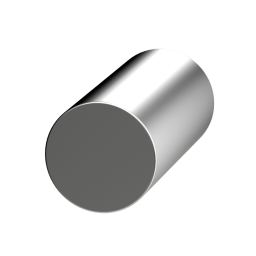
Billet
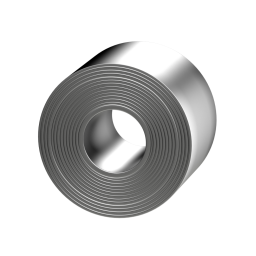
Coil
Disc
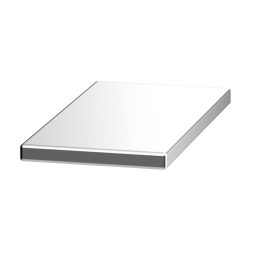
Flat Bar

Foil
Hollow Bar
Ingot
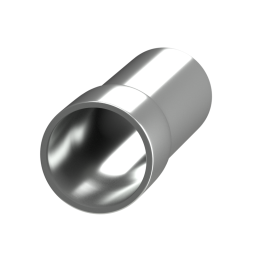
Pipe
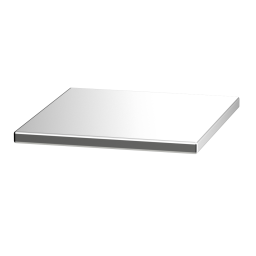
Plate
Ring
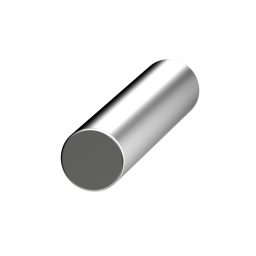
Rod
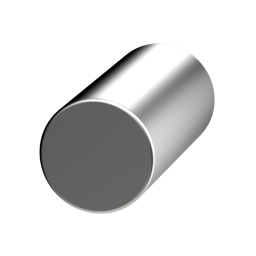
Round Bar
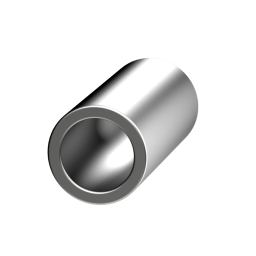
Round Tube
Sheet
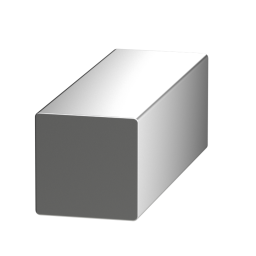
Square Bar
Strip
Additional Data
Specifications
4983,4984,4986,4987,R56410Chemical Elements
| Aluminum | 2.6 - 3.4 |
| Carbon | 0.05 max |
| Hydrogen 2 | 0.015 max |
| Iron | 1.6 - 2.2 |
| Nitrogen | 0.05 max |
| Oxygen | 0.13 max |
| Remainder Each | 0.1 max |
| Remainder Total | 0.3 max |
| Titanium | Balance |
| Vanadium | 9 - 11 |
| Yitrium | 0.005 max |
Physical Properties
Density: 0.174lb/in³
Melting Point: 3000°F
Specific Gravity: 4.65
Mechanical Properties
Modulus of Elasticity – Tension: 15MSI
Thermal Expansion
| Condition | Min | Max | Expansion Coefficient |
|---|---|---|---|
| Annealed | 32 °F | 212 °F | 4.9 μin/in·°F |
| Annealed | 32 °F | 600 °F | 5.2 μin/in·°F |
| Annealed | 32 °F | 1000 °F | 5.4 μin/in·°F |
Rupture Test Data
| Condition | Form | Temperature | Time | Rupture Strength |
|---|---|---|---|---|
| Solution Annealed & Aged | Sheet | 600 °F | 100 hrs | 140 KSI |
Mechanical Test Data
| Form | Sheet |
| Condition | Solution Annealed & Aged |
| Temperature | 70°F |
| Elongation | 6% |
| Tensile Strength | 170 KSI |
| Yield Strength | 160 KSI |
| Form | Sheet |
| Condition | Solution Annealed & Aged |
| Temperature | 600°F |