Titanium
Titanium 6Al-7Nb
Applications
Ti-6Al-7Nb is used primarily in the medical and surgical device industries. Typical applications include hip prostheses, artificial knee joints, bone plates, screws for fracture fixation, cardiac valve prostheses, pacemakers, spinal fixation devices, dental implants, and other surgical implants requiring long-term biocompatibility. It has been in clinical use since early 1986. Secondary applications include aerospace components requiring mechanical stability and moderate temperature performance.
Corrosion Resistance
Ti-6Al-7Nb exhibits excellent corrosion resistance, particularly in saline and physiological environments. The alloy spontaneously forms a stable, adherent titanium oxide film that provides high resistance to corrosion in body fluids, seawater, and most aqueous media. It demonstrates superior corrosion resistance compared to Ti-6Al-4V ELI in saline environments. The oxides formed are saturated in the body and are not transported in vivo, making the alloy highly biologically inert.
Heat Treatability
Ti-6Al-7Nb is heat treatable. Heat treatment significantly influences mechanical properties by reducing residual stresses and improving tensile and fatigue strength through solution treatment and aging. The alloy provides an optimal combination of ductility, machinability, and structural stability depending on the cooling rate and heat treatment applied. Annealing is the most common delivery condition per ASTM F1295 and ISO 5832-11. Solution treatment and aging (STA) can be used to achieve higher strength levels.
Hot Workability
Ti-6Al-7Nb belongs to the alpha-beta titanium alloy class and its thermal processing is similar to Ti-6Al-4V. General ingot heating temperature is in the range of 1150–1200°C (2100–2190°F). The alloy can be hot forged, precision forged, and hot rolled into bar, rod, ring, and forging products using conventional titanium alloy processing methods.
Machinability
Ti-6Al-7Nb has machining characteristics similar to Ti-6Al-4V. Like other alpha-beta titanium alloys, it requires sharp tooling, slow cutting speeds, high feed rates, and adequate non-chlorinated cutting fluid flood cooling. Tungsten carbide (C1–C4 grade) or cobalt-type high-speed steel tools are recommended. Close control of interstitial element content (C, O, N, H) improves deformation capability and machinability. The alloy exhibits good formability and cutting in the annealed condition.
Principle Design Features
Ti-6Al-7Nb is an alpha-beta titanium alloy (UNS R56700) first synthesized in 1977. It was developed as a biocompatible alternative to Ti-6Al-4V, substituting niobium for vanadium as the beta-stabilizing element. The alloy consists of a hexagonal alpha phase stabilized by aluminum and a body-centered cubic beta phase stabilized by niobium. It is double or triple vacuum arc melted to ensure a uniform and homogeneous ingot composition. Its mechanical and physical properties are closely comparable to Ti-6Al-4V, making it an established high-strength medical-grade titanium alloy.
Weldability
Ti-6Al-7Nb can be readily welded in the annealed condition using standard titanium welding practices. Welding must be performed in a controlled inert gas atmosphere (argon or helium) to prevent contamination by oxygen, nitrogen, and hydrogen. Post-weld stress relief annealing is recommended. The alloy's weldability is comparable to Ti-6Al-4V.
Known Forms
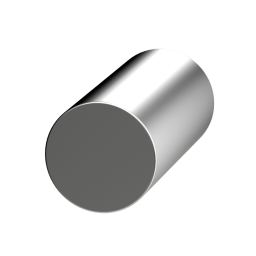
Billet
Disc
Ingot
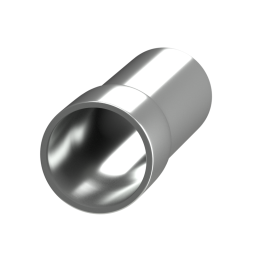
Pipe
Ring
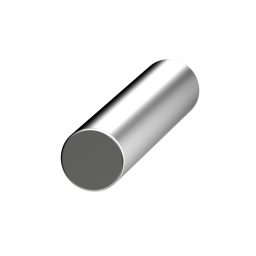
Rod
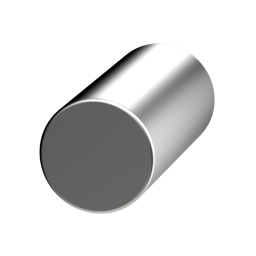
Round Bar
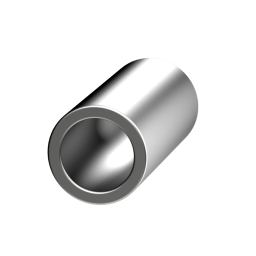
Round Tube
Additional Data
Specifications
F1295,5832-11,R56700Chemical Elements
| Aluminum | Per ASTM F1295 / ITA Specifications Book |
| Carbon | Max per ASTM F1295 / ITA Specifications Book |
| Hydrogen | Max per ASTM F1295 / ITA Specifications Book |
| Iron | Max per ASTM F1295 / ITA Specifications Book |
| Niobium | Per ASTM F1295 / ITA Specifications Book |
| Nitrogen | Max per ASTM F1295 / ITA Specifications Book |
| Oxygen | Max per ASTM F1295 / ITA Specifications Book |
| Tantalum | Max per ASTM F1295 / ITA Specifications Book |
| Titanium | Balance |
Physical Properties
Density: 0.163lb/in³
Modulus of Elasticity: 15.2MSI
Mechanical Test Data
| Form | Round Bar |
| Condition | Annealed |
| Temperature | 70°F |
| Elongation | 10% |
| Reduction of Area | 25% |
| Tensile Strength | 130.5 KSI |
| Yield Strength | 116 KSI |
| Form | Rod |
| Condition | Annealed |
| Temperature | 70°F |
| Elongation | 10% |
| Reduction of Area | 25% |
| Tensile Strength | 130.5 KSI |
| Yield Strength | 116 KSI |