Titanium
Titanium 8Al-1Mo-1V
Annealing Procedure
Single--Hold at 738 C(1450 F) for 8 hours, furnace cool. Duplex--Perform single annealing plus heat to 788 C(1450 F) for 1/4 hour and air cool.(For bars and forgings, heat to 900 C(1670 F) for 1 hour and water or air quench, plus 593 C(1100 F) for 8 hours, air cool.) For Stress relief annealing, hold at 593-649 C(1100-1200 F) for 1 hour and air cool.
Applications
Found primarily in jet engine applications such as forged fan and compressor blades.
Cold Workability
The cold working characteristics of this material are similar to those of austenitic stainless steels. In multiple forming operations, intermediate stress relieving is recommended to offset the alloy's tendency to work harden. Post-work annealing is required to re-attain optimum performance characteristics.
Forgeability
Rough at 1010-1038 C(1850-1900 F), finish at 1010 C(1850 F).
Formability
This alloy may be hot or cold formed. Popular methods include hydropress, stretch or drop-hammer. This material responds similarly to 300 series stainless steels.
Hot Workability
Hot forming will reduce both the springback and required forming forces, and will increase the overall ductility of the material.
Machinability
As a family, titanium and its alloys have developed a mystique as a nightmare to machine. This is simply not the case. Experienced operators have compared its characteristics to those found in 316 stainless steel. Recommended practice includes high coolant flow(to offset the material's low thermal conductivity), slow speeds and relatively high feed rates. Tooling should be tungsten carbide designations C1-C4 or cobalt type high speed tools.
Other Physical Properties
Beta Transus (F +/- 25) 1900
Principle Design Features
This near alpha alloy was created primarily to resist creep up to 805 F. It possesses the highest tensile strength and lowest density of any of the titanium alloys. It is available at the mill in bar, billet, plate, sheet, strip, extrusions and wire. Beta Transus (F +/- 25) 1900.
Weldability
Rated as "fair in terms of weldability.
Known Forms
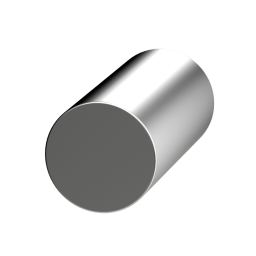
Billet
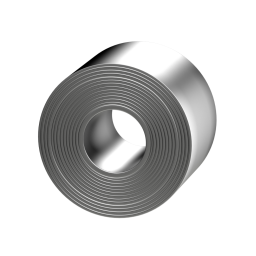
Coil
Disc
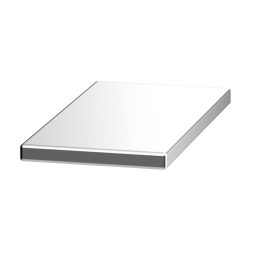
Flat Bar
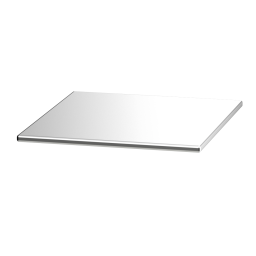
Foil
Hollow Bar
Ingot
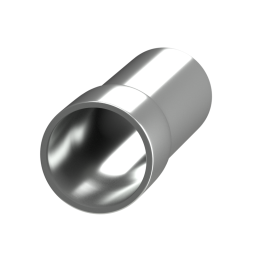
Pipe
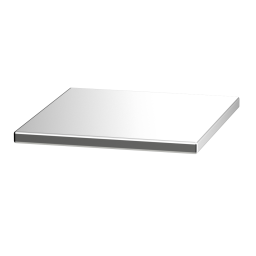
Plate
Ring
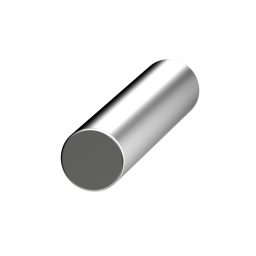
Rod
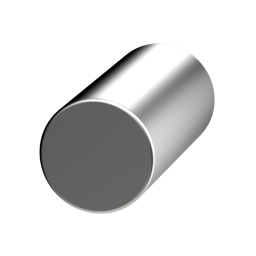
Round Bar
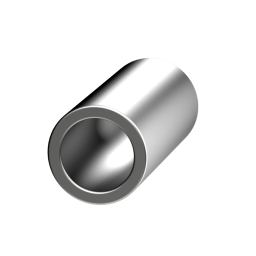
Round Tube
Sheet
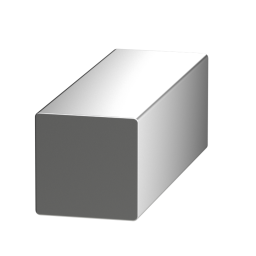
Square Bar
Strip
Additional Data
Specifications
4915,4916,4933,4955,4972,4973,F-83142,T-81556,T-9046,T-9047,R54810Chemical Elements
| Aluminum | 7.35 - 8.35 |
| Carbon | 0.08 max |
| Hydrogen 2 | 0.0125 max |
| Iron | 0.3 max |
| Molybdenum | 0.75 - 1.25 |
| Nitrogen | 0.05 max |
| Oxygen | 0.12 max |
| Titanium | Balance |
| Vanadium | 0.75 - 1.25 |
Physical Properties
Density: 0.158lb/in³
Electrical Resistivity: 199µΩ·cm
Mechanical Properties
Modulus of Elasticity – Tension: 18.5MSI
Thermal Expansion
| Condition | Min | Max | Expansion Coefficient |
|---|---|---|---|
| Annealed | 32 °F | 212 °F | 4.7 μin/in·°F |
| Annealed | 32 °F | 600 °F | 5 μin/in·°F |
| Annealed | 32 °F | 1000 °F | 5.6 μin/in·°F |
| Annealed | 32 °F | 1200 °F | 5.7 μin/in·°F |