Titanium
Titanium Grade 2
Annealing Procedure
Annealing of CP Ti Grade 2 wrought products is performed at temperatures of 1200°F to 1400°F (649°C to 760°C) for 6 minutes to 2 hours, followed by an air cool. Annealing at temperatures below the beta transus results in a fully recrystallized equiaxed alpha structure. Precise control of grain size and mechanical properties can be achieved by adjusting the anneal temperature. Intermediate and final annealing is preferably performed in a vacuum or inert gas atmosphere to avoid alpha case formation. Parts must be thoroughly cleaned prior to vacuum heat treatment to prevent alpha case formation from surface contamination.
Applications
Chemical processing equipment including heat exchangers, reactors, pressure vessels, piping, and liners. Marine and desalination systems including seawater piping, condensers, and evaporators. Aerospace non-structural components including airframe skins in warm areas, ducting, brackets, and galley equipment. Medical devices including dental implants, bone plates, surgical instruments, and prosthetics where biocompatibility is required. Oil and gas components, flue-gas desulfurization systems, cryogenic vessels, electroplating jigs and cathodes, and spacecraft fuel tank liners and plumbing.
Cold Workability
CP Ti Grade 2 exhibits excellent cold workability. It can be cold-formed, drawn, rolled, and bent using standard equipment. The material work-hardens during cold forming, and strength can increase approximately 20–30% after cold working with a corresponding reduction in elongation. Due to the low modulus, springback is significant and must be accounted for in tooling design. Stress relieving at 900–1100°F is used to recover compressive yield strength lost due to the Bauschinger effect after cold forming.
Corrosion Resistance
Grade 2 titanium exhibits outstanding corrosion resistance due to a stable, self-healing, tightly adherent oxide film that forms spontaneously upon exposure to oxygen or moisture. This film provides resistance to most oxidizing, neutral, and mildly reducing environments. Grade 2 is resistant to seawater and marine atmospheric corrosion, moist chlorides, metallic chlorides, chlorite and hypochlorite solutions, nitric and chromic acids, organic acids, alkaline media, and many industrial gases. In seawater, it is fully corrosion resistant up to 600°F (315°C). Crevice corrosion may occur in hot halide or sulfate solutions above 75°C. Grade 2 is fully resistant to stress-corrosion cracking (SCC) in aqueous solutions, but is susceptible in anhydrous methanol, red fuming nitric acid, nitrous oxide, liquid cadmium, and liquid mercury. Susceptible to hydrogen embrittlement from hydride formation; maximum hydrogen content is typically limited to 150 ppm in mill product specifications.
Formability
CP Ti Grade 2 has good ductility and excellent cold formability. Minimum bend radius for material under 0.070 inch thick is 2T; for material over 0.070 inch, 2.5T is recommended. Due to titanium's low modulus of elasticity, significant springback allowances must be made. The Bauschinger effect can result in a drop of up to 25% in compressive yield strength after stretching at room temperature; this can be recovered by stress relieving. Hot sizing after cold forming is often used to correct for springback variations. Surface conditioning to remove alpha case may be required after forming.
Hot Workability
CP Ti Grade 2 can be hot worked by conventional techniques including hot rolling, forging, and hot pressing. Temperatures for initial roughing may be as high as 50–100°F (30–50°C) above the beta transus. Finish processing temperatures are typically in the alpha/beta phase field, ranging from approximately 1500°F to 1650°F (815°C to 900°C). More severe forming operations are typically performed in the range of 900–1000°F (480–540°C), while milder forming can be done at 400–600°F (200–315°C). Care must be taken to prevent formation of excessive alpha case during elevated-temperature processing, and alpha case must be removed after heat treatment.
Machinability
The machining characteristics of CP Ti Grade 2 are similar to those of austenitic stainless steels. Low cutting speeds, heavy feed rates, and copious amounts of cutting fluid are recommended. Sharp tools and rigid setups are essential. Because of titanium's strong tendency to gall and smear, feeding should never be stopped while the tool and workpiece are in moving contact. Non-chlorinated cutting fluids are recommended to eliminate the possibility of chloride-induced stress-corrosion cracking. Titanium chips are highly combustible and appropriate safety precautions are necessary.
Other Mechanical Properties
Modulus of Rigidity (Shear Modulus): approximately 5,900 ksi (41 GPa). Poisson's Ratio: 0.32. The material has high fatigue strength in both air and chloride environments. Grade 2 maintains good mechanical properties at both low and elevated temperatures; it is approved for use down to -75°F under ASME BPVC guidelines and can operate in continuous service up to 800°F, with intermittent service capability to 1000°F. Hardness is approximately 80 HRB (Rockwell B) in the annealed condition.
Other Physical Properties
Beta transus temperature: approximately 1625°F (885°C). The material is non-magnetic with a magnetic permeability of approximately 1.00005. Crystal structure is hexagonal close-packed (HCP) alpha phase at service temperatures, transforming to body-centered cubic (BCC) beta phase above the beta transus. Poisson's Ratio: 0.32. Modulus of Rigidity: 5,900 ksi (41 GPa). The material has very short radioactive half-life and is nontoxic, nonallergenic, and fully biocompatible.
Principle Design Features
Titanium Grade 2 (UNS R50400) is the most widely used commercially pure (CP) titanium grade. It is an unalloyed, single-phase alpha-titanium with a hexagonal close-packed (HCP) crystal structure. It offers an excellent balance of moderate strength, outstanding corrosion resistance, and good formability and weldability. Its properties are controlled primarily by iron and interstitial elements (oxygen, nitrogen, carbon, hydrogen) and grain size. It is non-magnetic and has been approved for sour service use under NACE MR-01-75. Often referred to as the 'workhorse' of the CP titanium family.
Weldability
CP Ti Grade 2 has excellent weldability. It can be welded using gas tungsten arc welding (GTAW/TIG), which is the most common process, as well as gas metal arc welding (GMAW/MIG) for thicker sections, plasma arc welding, electron beam, laser beam, resistance welding, and diffusion welding. Inert gas shielding (argon or argon/helium mixture) must be employed to prevent oxygen and nitrogen pickup and embrittlement of the weld and heat-affected zone. Preheat or post-heat treatments are not required. Back-shielding and trailing shields are recommended for full protection of the weld zone.
Known Forms
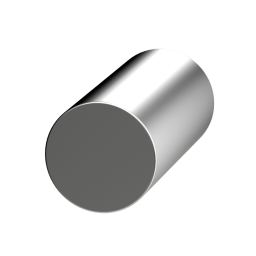
Billet
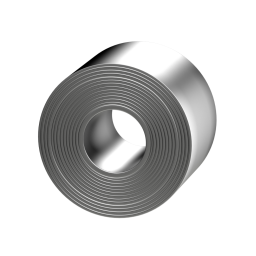
Coil
Disc
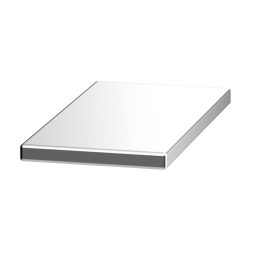
Flat Bar
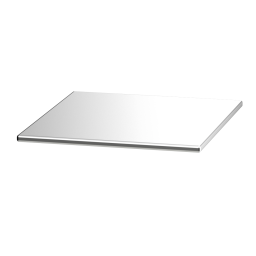
Foil
Hollow Bar
Ingot
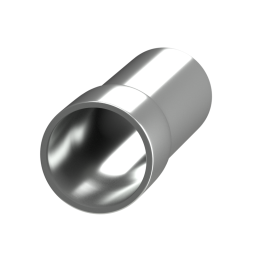
Pipe
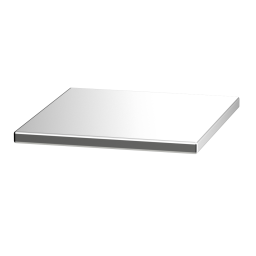
Plate
Powder
Ring
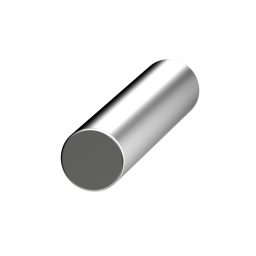
Rod
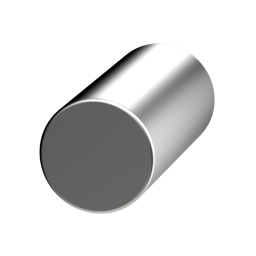
Round Bar
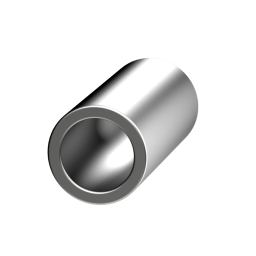
Round Tube
Sheet
Specialty Form
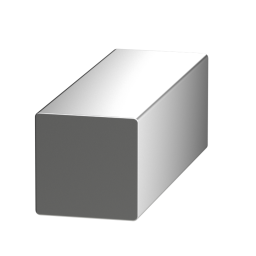
Square Bar
Strip
Wire Round
Additional Data
Specifications
4902,4941,4942,B265,B337,B338,B348,B381,F467,F468,F67,R50400,B367,B861,B862,B863,SB-265,SB-348,SB-338,SB-381Chemical Elements
| Carbon | Max per ASTM B265 Grade 2 |
| Hydrogen | Max per ASTM B265 Grade 2; lower values may be obtained by negotiation with manufacturer |
| Iron | Max per ASTM B265 Grade 2 |
| Nitrogen | Max per ASTM B265 Grade 2 |
| Oxygen | Max per ASTM B265 Grade 2 |
| Titanium | Balance |
Physical Properties
Density: 0.163lb/in³
Electrical Resistivity: 53.3µΩ·cm
Melting Point: 3000°F
Modulus of Elasticity: 15.2MSI
Specific Heat: 0.124BTU/lb·°F
Mechanical Properties
Poisson's Ratio: 0.32
Thermal Conductivity: 12.6BTU/hr·ft·°F
Thermal Conductivity
| Condition | Temperature | Conductivity |
|---|---|---|
| Annealed | 70 °F | 12.6 BTU/hr·ft·°F |
Thermal Expansion
| Condition | Min | Max | Expansion Coefficient |
|---|---|---|---|
| Annealed | 68 °F | 212 °F | 4.8 μin/in·°F |
Mechanical Test Data
| Form | Sheet |
| Condition | Annealed |
| Temperature | 70°F |
| Elongation | 20% |
| Rockwell Hardness | B80 |
| Tensile Strength | 50 KSI |
| Yield Strength | 40 KSI |
| Form | Strip |
| Condition | Annealed |
| Temperature | 70°F |
| Elongation | 20% |
| Rockwell Hardness | B80 |
| Tensile Strength | 50 KSI |
| Yield Strength | 40 KSI |
| Form | Plate |
| Condition | Annealed |
| Temperature | 70°F |
| Elongation | 20% |
| Rockwell Hardness | B80 |
| Tensile Strength | 50 KSI |
| Yield Strength | 40 KSI |
| Form | Round Bar |
| Condition | Annealed |
| Temperature | 70°F |
| Elongation | 20% |
| Reduction of Area | 30% |
| Rockwell Hardness | B80 |
| Tensile Strength | 50 KSI |
| Yield Strength | 40 KSI |
| Form | Rod |
| Condition | Annealed |
| Temperature | 70°F |
| Elongation | 20% |
| Reduction of Area | 30% |
| Rockwell Hardness | B80 |
| Tensile Strength | 50 KSI |
| Yield Strength | 40 KSI |
| Form | Billet |
| Condition | Annealed |
| Temperature | 70°F |
| Elongation | 20% |
| Reduction of Area | 30% |
| Rockwell Hardness | B80 |
| Tensile Strength | 50 KSI |
| Yield Strength | 40 KSI |