Titanium
Titanium Grade 7
Annealing Procedure
Anneal by heating to 1202–1400°F (650–760°C), hold for 6 minutes to 2 hours depending on section thickness, then air cool. For stress relief only, heat to 896–1103°F (480–595°C), hold for 15 minutes to 4 hours, then air cool. Annealing is preferably performed in a vacuum or inert atmosphere to prevent alpha-case formation.
Applications
Titanium Grade 7 is used primarily in chemical processing and production equipment components where exceptional corrosion resistance is required. Typical applications include chemical storage and processing containers, heat exchangers, ducting, pumps, valves, fittings and auxiliary equipment, desalination equipment, and power generation systems. It is the preferred material for handling reducing acids and aggressive halide-containing environments.
Cold Workability
Grade 7 exhibits good cold workability comparable to Grade 2 CP titanium. It can be cold drawn, rolled, and formed. Intermediate annealing may be required for extensive cold reduction to restore ductility. Springback due to the low modulus of elasticity must be anticipated in forming operations.
Corrosion Resistance
Grade 7 is recognized as the most corrosion-resistant of all titanium alloys. The addition of palladium substantially improves resistance to general and crevice corrosion in reducing acid environments (e.g., sulfuric acid, hydrochloric acid, phosphoric acid) and at elevated temperatures above 180°F (83°C). It also performs excellently in oxidizing environments, chloride salt solutions, nitric acid, chromic acid, and wet chlorine. The palladium expands the range of pH and temperatures at which titanium maintains its passive oxide film.
Formability
Grade 7 has excellent formability comparable to Grade 2 commercially pure titanium. It can be cold formed, drawn, bent, and otherwise fabricated using standard titanium processing equipment. Due to titanium's relatively low modulus of elasticity, springback must be accounted for in bending operations. Warm forming at intermediate temperatures improves formability for complex shapes.
Heat Treatability
Titanium Grade 7 is a single-phase alpha alloy and cannot be significantly strengthened by heat treatment. Stress relief annealing and full annealing are the only applicable heat treatment processes. Solution treatment and aging are not applicable to this grade.
Hot Workability
Grade 7 can be hot worked by standard methods including hot rolling, forging, and extrusion. Hot working is typically performed below the beta transus temperature (approximately 1675°F ± 25°F). Processing in the alpha or alpha+beta field refines the microstructure and maintains the mechanical properties characteristic of the grade.
Machinability
Titanium Grade 7 can be machined using conventional equipment, but requires careful attention to cutting parameters. Recommended practices include low cutting speeds, high feed rates, sharp tooling, and generous application of cutting fluid to minimize work hardening and tool wear. Titanium's low thermal conductivity causes heat to concentrate at the cutting tool rather than dispersing through the workpiece.
Other Comments
Titanium Grade 7 is part of a family of palladium-enhanced titanium alloys including Grades 11, 16, and 17. Grade 11 is a lower-oxygen variant of Grade 7 with similar properties. Grades 16 and 17 contain 0.04–0.08% Pd (a leaner Pd content) and offer similar but slightly reduced corrosion resistance at lower cost. Grade 7H (UNS R52400) is a variant with a higher guaranteed minimum UTS of 58 ksi, intended primarily for pressure vessel use. The DIN equivalent designation is W.Nr. 3.7235.
Other Physical Properties
Beta Transus Temperature: approximately 1675°F ± 25°F (913°C ± 14°C). The alloy is non-magnetic. Poisson's ratio is approximately 0.37. The alloy is biocompatible, though its primary application is industrial rather than medical.
Principle Design Features
Titanium Grade 7 (UNS R52400) is an unalloyed titanium modified by the addition of 0.12–0.25% palladium. It is mechanically and physically equivalent to Titanium Grade 2 but exhibits significantly enhanced corrosion resistance, particularly in reducing acid environments and hot halide media. The palladium addition promotes the formation of a stable protective oxide film in environments where pure titanium may be susceptible to attack. It is a single-phase alpha-titanium alloy with a hexagonal close-packed crystal structure.
Weldability
Titanium Grade 7 has excellent weldability using standard titanium welding processes such as GTAW (TIG) and PAW. Welding must be performed with adequate inert gas shielding (argon or helium) on both the front and back sides of the weld to prevent contamination by oxygen, nitrogen, and hydrogen. No post-weld heat treatment is typically required. The single-phase alpha microstructure is not significantly affected by welding thermal cycles.
Known Forms
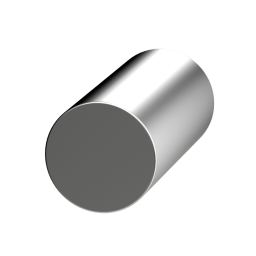
Billet
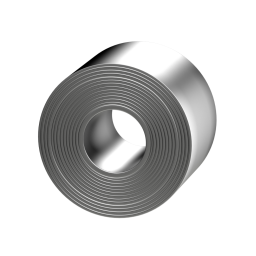
Coil
Disc
Fitting
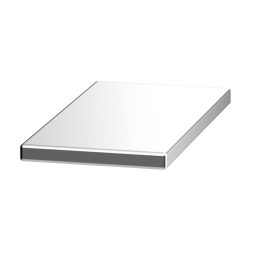
Flat Bar
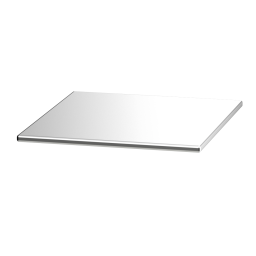
Foil
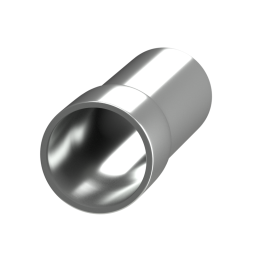
Pipe
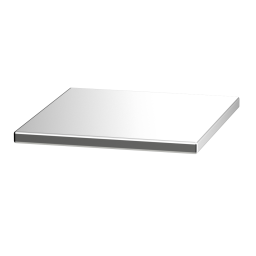
Plate
Ring
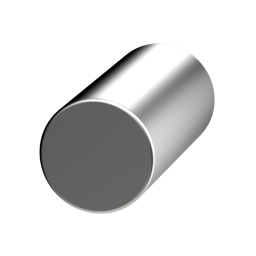
Round Bar
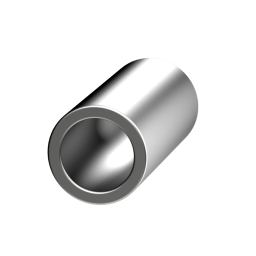
Round Tube
Sheet
Strip
Wire Round
Additional Data
Specifications
4921,B265,B338,B348,B381,F467,F468,R52400,B367,SB-265,SB-348,SB-338,SB-381Chemical Elements
| Carbon | 0.08 max |
| Hydrogen | 0.015 max |
| Iron | 0.3 max |
| Nitrogen | 0.03 max |
| Oxygen | 0.25 max |
| Palladium | 0.12 - 0.25 |
| Titanium | Balance |
Physical Properties
Density: 0.163lb/in³
Electrical Resistivity: 56µΩ·cm
Melting Point: 3030°F
Modulus of Elasticity: 15.2MSI
Specific Heat: 0.124BTU/lb·°F
Thermal Conductivity
| Condition | Temperature | Conductivity |
|---|---|---|
| Annealed | 70 °F | 12 BTU/hr·ft·°F |
Thermal Expansion
| Condition | Min | Max | Expansion Coefficient |
|---|---|---|---|
| Annealed | 68 °F | 212 °F | 4.8 μin/in·°F |
Mechanical Test Data
| Form | Sheet |
| Condition | Annealed |
| Temperature | 70°F |
| Brinell Hardness | 145 HB |
| Elongation | 20% |
| Tensile Strength | 50 KSI |
| Yield Strength | 40 KSI |
| Form | Plate |
| Condition | Annealed |
| Temperature | 70°F |
| Brinell Hardness | 145 HB |
| Elongation | 20% |
| Tensile Strength | 50 KSI |
| Yield Strength | 40 KSI |
| Form | Strip |
| Condition | Annealed |
| Temperature | 70°F |
| Brinell Hardness | 145 HB |
| Elongation | 20% |
| Tensile Strength | 50 KSI |
| Yield Strength | 40 KSI |
| Form | Round Bar |
| Condition | Annealed |
| Temperature | 70°F |
| Brinell Hardness | 145 HB |
| Elongation | 20% |
| Reduction of Area | 30% |
| Tensile Strength | 50 KSI |
| Yield Strength | 40 KSI |
| Form | Billet |
| Condition | Annealed |
| Temperature | 70°F |
| Brinell Hardness | 145 HB |
| Elongation | 20% |
| Reduction of Area | 30% |
| Tensile Strength | 50 KSI |
| Yield Strength | 40 KSI |