Tool Steel
Tool Steel M50
Annealing Procedure
Heat to 1600 F and furnace cool slowly. M50 is extremely susceptible to decarburization and must be protected during any thermal treatment.
Applications
Most often employed in tooling applications where abrasion resistance is less important, such as woodworking tools and commercial twist drills. In its VIM/VAR form, M50 has become useful in the bearing and missile industry for high wear resistance and strength at high temperatures.
Forgeability
Preheat to 1500 F and soak thoroughly. Then increase temperature to 2000 F prior to working. Do not forge below 1800 F.
Formability
Not applicable
Hardening Procedure
For optimum performance and stability, preheat work to 1500 F until soaked, then superheat to 2000 F only long enough for the work to reach furnace temperature and quench immediately. Cool the work to -100 F and soak for 1 hour.
Heat Treatability
See annealing, tempering and hardening.
Machinability
This alloy is best machined in the annealed condition. It is rated at 65 % of a 1% carbon steel, or 50% of a B1112.
Principle Design Features
Commonly produced by VIM - VAR methods, this M50 is an intermediate high speed, molybdenum type tool steel.
Tempering Procedure
Tempering should immediately follow quenching. For best performance, double temper at 1025 F.
Known Forms
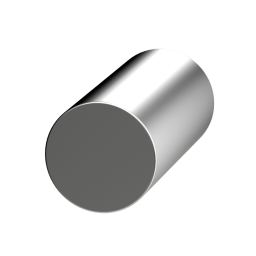
Disc
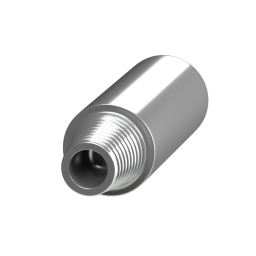
Drill Rod
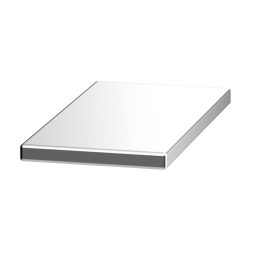
Flat Bar
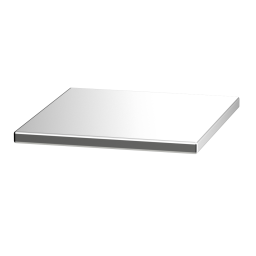
Plate
Precision Ground Bar
Ring
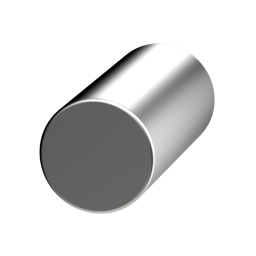
Round Bar
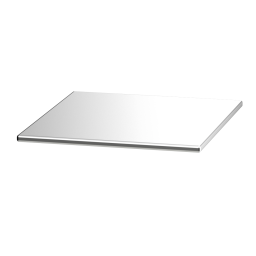
Sheet
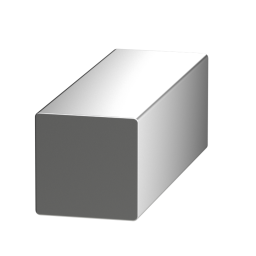
Square Bar
Additional Data
Specifications
6490,6491,A600 (M 50),A600 (M50),1.3551Chemical Elements
| Carbon | 0.77 - 0.85 |
| Chromium | 3.75 - 4.25 |
| Cobalt | 0.25 max |
| Copper | 0.1 max |
| Iron | Balance |
| Manganese | 0.35 max |
| Molybdenum | 4 - 4.5 |
| Nickel | 0.15 max |
| Phosphorus | 0.015 max |
| Silicon | 0.25 max |
| Sulphur | 0.015 max |
| Tungsten | 0.25 max |
| Vanadium | 0.9 - 1.1 |
Physical Properties
Density: 0.283lb/in³