Tool Steel
Tool Steel P20
Aging Procedure
Not applicable to this alloy.
Annealing Procedure
Anneal at 1400 to 1450 F and slow cool in the furnace at a rate of less than 40 F per hour.
Applications
Typically used for relatively low temperature applications such as die casting dies and injection molds.
Cold Workability
P20 may be readily cold worked by conventional tooling with the alloy in the annealed condition.
Forgeability
Forge at 2000 F down to 1650 F. Do not forge below 1600 F.
Formability
P20 may readily be formed by conventional methods with the alloy in the annealed condition.
Hardening Procedure
See "Heat Treating" and "Tempering".
Heat Treatability
For carburizing heat to 1600-1650 F in the carburizing medium. For hardening after carburizing heat to 1500 - 1600 F and hold for 15 minutes then oil quench.
Hot Workability
See "Forging".
Machinability
Machinability is relatively good at about 80% that of the W group water hardening steels.
Principle Design Features
This alloy is in the category generally labeled as Mold Steels. Nickel and chromium are the alloying elements for hardness and toughness. This alloy is most often used in the carburized condition.
Tempering Procedure
Temper at 900 to 1100 F for a Rockwell C hardness of 37 to 28.
Weldability
This alloy is weldable by conventional methods. Contact the alloy supplier for details and weld procedures.
Known Forms
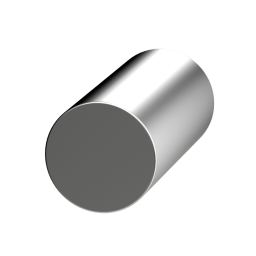
Disc
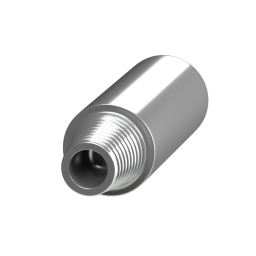
Drill Rod
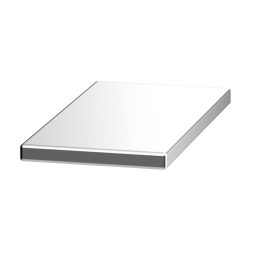
Flat Bar
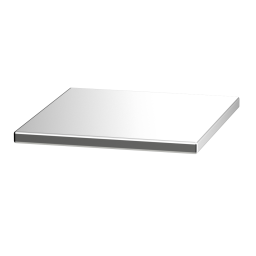
Plate
Precision Ground Bar
Ring
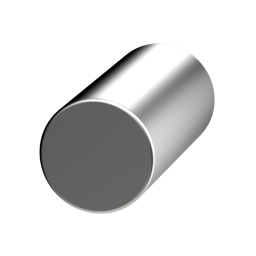
Round Bar
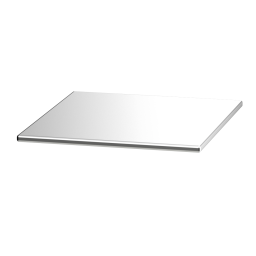
Sheet
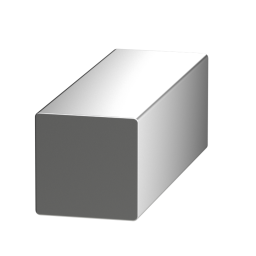
Square Bar
Additional Data
Specifications
A681,T51620Chemical Elements
| Carbon | 0.28 - 0.4 |
| Chromium | 1.4 - 2 |
| Iron | Balance |
| Manganese | 0.6 - 1 |
| Molybdenum | 0.3 - 0.55 |
| Phosphorus | 0.03 max |
| Silicon | 0.2 - 0.8 |
| Sulphur | 0.03 max |
Physical Properties
Density: 0.283lb/in³
Melting Point: 2600°F
Specific Gravity: 7.85
Mechanical Properties
Modulus of Elasticity – Tension: 29MSI