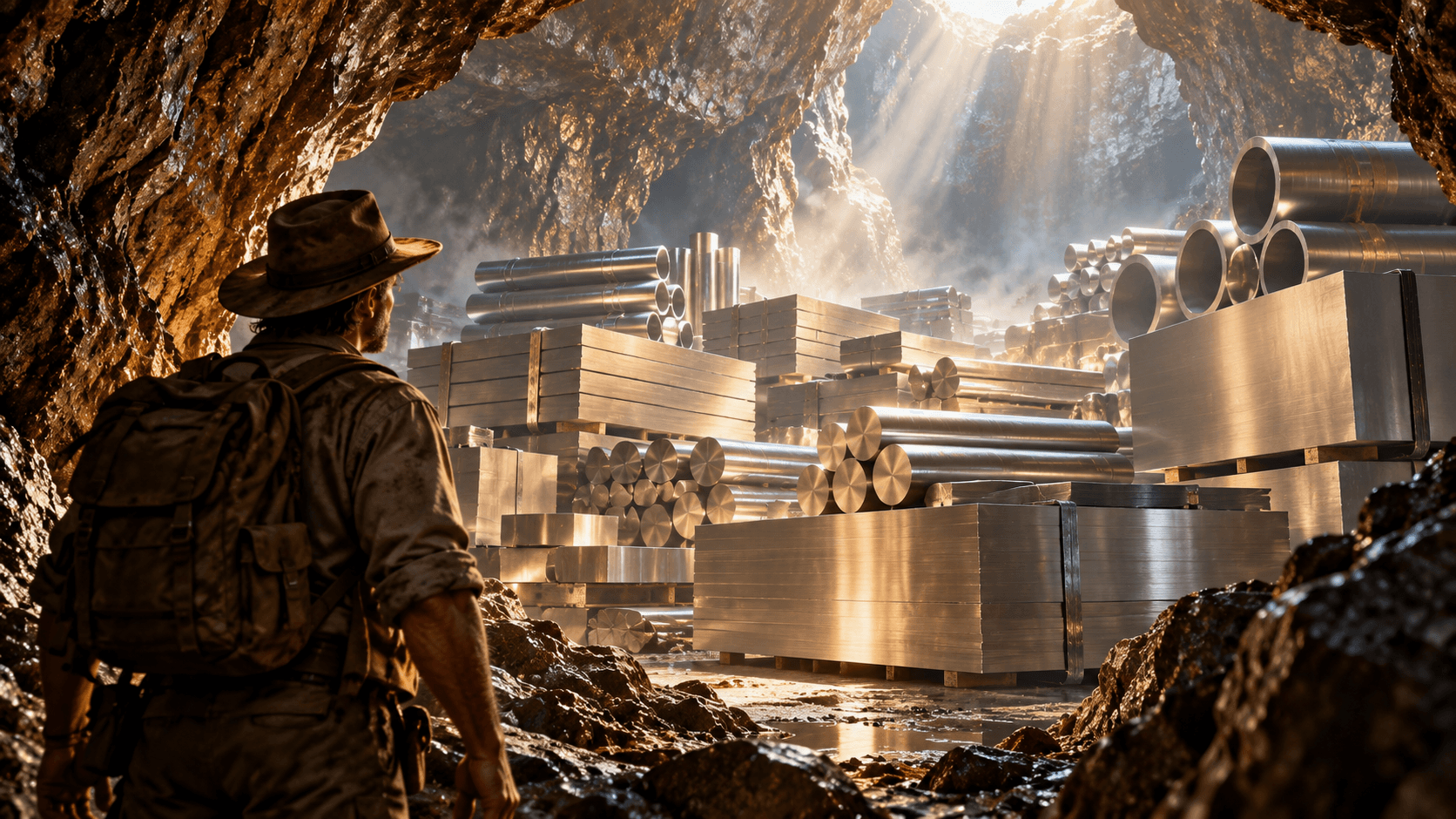
Why Is Inconel So Expensive?
October 1, 2026
Grant’s Field Journal
Mission: Understand what makes Inconel command such a premium
Terrain: Nickel, specialty alloys and difficult sourcing
Difficulty: ★★★★☆
Status: Mystery explored
If you’ve ever requested a quote for Inconel and had to look at the number twice, you’re not alone.
Compared with carbon steel—and even many stainless grades—Inconel can come with serious sticker shock.
But there’s more behind that price than an exotic name. From the elements that go into the alloy to the difficulty of producing and machining it, several factors contribute to the final cost.
Let's explore.
First, what exactly is Inconel?
Inconel isn't one specific alloy. It's a family of nickel-based alloys engineered to perform in environments where many conventional metals struggle.

Different Inconel alloys are designed for different applications, but the family is known for combinations of high-temperature strength and resistance to oxidation and corrosion. That makes these alloys valuable in demanding applications such as aerospace, power generation and industrial processing.
That performance comes from some decidedly non-ordinary ingredients.
Expedition Stop #1: Expensive elements
Start with nickel.
Then keep going.
For example, INCONEL alloy 625 contains at least 58% nickel, along with 20–23% chromium, 8–10% molybdenum and 3.15–4.15% niobium plus tantalum.
Those aren't carbon-steel economics.
And the cost of those raw materials can move considerably. According to some raw-material averages, nickel is listed at $7.60/lb., molybdenum at $33.34/lb., and niobium at $57.50/lb.
So when the cost of those ingredients changes, the economics of producing Inconel can change with them.
Grant's note: When you're buying a highly alloyed material, you're not just buying metal. You're buying a very specific recipe of expensive elements designed to deliver very specific performance.
Expedition Stop #2: It's difficult to make
Getting the chemistry right is only the beginning.
Specialty nickel alloys require carefully controlled melting, processing and production to achieve their intended properties. Some variants involve alloying and processing specifically controlled around demanding performance requirements.
That additional processing, control and quality assurance all become part of the material's cost.
And depending on the application, specifications, testing and documentation can add another layer to the sourcing equation.
Expedition Stop #3: It's not always easy to machine
The characteristics that make Inconel valuable in extreme applications can also make it challenging once it reaches the shop.
Machining can require slower speeds, appropriate tooling and careful process control. Special Metals' machining guidance for alloy 625, for example, provides relatively low recommended cutting speeds depending on the tooling being used.
More difficult machining can mean more machine time, greater tooling considerations and ultimately higher finished-part costs.
In other words, the price of the raw material may only be part of the Inconel cost story.
Expedition Stop #4: You're shopping in a smaller world
Here's where things get especially interesting for buyers.
You may not actually have an Inconel problem.
You may have an:
Inconel 625 problem.
0.375-inch-thick Inconel sheet problem.
AMS specification problem.
One-piece Inconel problem.
Need-it-next-week problem.
Specialty alloys aren't stocked in every combination of grade, form, size, condition and specification.
The more requirements you add to the search, the smaller the pool of potential inventory can become.
And that's when an expensive material can become an expensive and hard-to-find material.
So, how can buyers control Inconel costs?
You can't change what goes into the alloy.
But you can make sure you're not unnecessarily narrowing your sourcing options.
Before sending the next RFQ, consider these questions:
Do I need this exact alloy?
The application may require it. If alternatives are permitted, however, understanding the actual performance requirements can open additional possibilities.
Do I need this exact size or form?
A nearby thickness, diameter or product form may be more readily available.
What specifications are truly required?
Don't remove requirements that matter—but understand which requirements are application-critical and which may simply have been carried forward from an older drawing.
How much do I really need?
Small quantities can create their own sourcing challenges, particularly when traditional suppliers impose minimums.
How flexible is my lead time?
Available inventory and made-to-order material are two very different expeditions.
Any material substitution or specification change should, of course, be reviewed and approved by the appropriate engineering or technical authority.
The Explorer's Takeaway
So, why is Inconel so expensive?
Expensive ingredients + specialized production + difficult processing + a smaller supply universe.
But when an Inconel quote looks unusually high—or nobody wants to quote it at all—the alloy itself may not be the entire problem.
Look at the complete requirement:
Grade. Size. Form. Condition. Specification. Quantity. Timing.
One of those details may be turning a difficult search into a hunt for Unobtainium.
And that's when the expedition really begins.
Having Trouble Finding Inconel?
If you've already searched the usual places, don't assume the material doesn't exist.
Tell Grant what you're looking for—grade, size, form, specification and quantity—and let Metals Suppliers Online explore the options.